Tuesday, March 11, 2014

Delusions of Power

Delusions of Power: New Explorations of the State, War, and Economy
In this book Robert Higgs summarizes his ideas on why we have to challenge the existence of government. One by one he knocks down, as dominoes, the rationalization to preserve government. 

Many people can't imagine a world without government because we were raise, by government, to believe it is a necessary institution. If humans had the creativity to create governments, we have so to create its substitute. Innovation has being restrained by the straw man discourse from governments. Like Dickens' Emperor Clothes we are reluctant to see, and Higgs does a great job in opening our eyes to understand that a world without government (as we know it) is not the same as a world of chaos.

Delusions of Power: New Explorations of the State, War, and Economy is a relevant book in the current political arena where parties keep up with the enchanting promises and people keep up believing in them.

My rating: 4 of 5 stars

Monday, February 10, 2014

Madmen, Intellectuals, and Academic Scribblers:


Wayne Leighton and Ed Lopez present in Madmen, Intellectuals and Academic Scribblers an interesting interpretation of the dynamic of regulations. Beginning with a clear fast forward history of philosophy they set the ground to present their model. Overall the book builds on Public Choice ideas adding the perspective of the entrepreneur of ideas. Contrary to common belief that ideas change only through crisis and revolutions, Leighton and Lopez explain the role of the Entrepreneurs of Ideas. If institutions are sound there is no need to revolutions, just a dynamic that resembles the spontaneous order in a market of ideas.

Each one of the roles act at different levels in society affecting the probabilities of ideas to win in the market. Each actor adequate the message to a different audience from the one who generate the ideas to the people who vote for them in the democratic game.


The book left me thinking on what was behind the scenes of current policies and regulations, and what new ones are in the making.

Friday, January 17, 2014

The Forgotten Man

It is a common believe that you can boil a frog to dead. Truth or not it is my impression of what happened to the USA founded by Thomas Jefferson and the rest of the Founding Fathers. The USA today, and most of the western world, is far from the country build in the late XVIII century.

I always wonder how such change could be permitted. Amity Shlaes fill a big part of the puzzle by vividly describing the Roosevelth era. He and his Stalin captivated socialist intellectuals were not a progressive but disruptive force. Much of the big changes in government role began during this years.

The Forgotten Man is an important reading for all who are concerned with the present times. A call to action to fight for Freedom and its principles. Pres. Obama is FDR reloaded and I hope that in 70 years we won't be reading the book "You didn't build it" describing the last stroke of socialism over the free world.

Shales made an excellent job reenacting this inflection time in history.

My rating: 5 of 5 stars

Sunday, September 8, 2013

The Capitalist Manifesto


I mostly enjoyed Andy Bernstein well supported case in defense of the Creative Minds and the Inventive Period. History has condemned the most productive minds of the XIX century. As humans, they were not perfect but sure were no "Robber Barons". As productive geniuses we should take their example of the only proven way to quickly improve living standards for all. 

The Capitalist Manifesto uses the Inventive Period and its creative minds as an historic framework to explain the philosophical virtues of Capitalism. A typical error that Andy addresses here is the temptation to compare life in the late XVIII to XIX to the present. People didn't have the choice of the down of the Industrial Revolution and today standard of living, their choice was a miserably poor life in the countryside. People migrated because the conditions were much better than their alternative. Current conditions are the result of the accumulation of Capital that started almost three hundred years ago.

Highly recommended book for those in need of arguments to defend freedom from the its enemies.

Tuesday, March 12, 2013

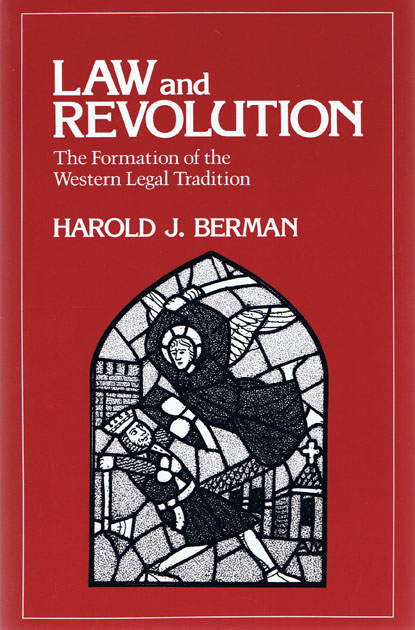
Law and Revolution


Harold J. Berman thesis presents how the seeds of the Enlightenment, the Industrial Revolution and the Capitalist society were planted in the Middle Ages after the Papal Revolution. By elaborating on the the parallels of different kingdoms after the Papal Revolution he shows in Law and Revolution how they built upon the experience of the establishment of the Church as a State. The rivalry between the Pope and the King, the interrelationship between different kingdoms, and the mobility of people and goods help to spread the systemic view of the Law as a tool for management of societies.

Berman thesis opens a lot of questions. For instance. Is it possible for other traditions to adopt the benefits of the Western Traditions considering that they didn't go through such long and evolutionary process? Is the traditional misconception of the origins of the western tradition a source of conflict with other parts of the world? Is the Legal tradition actually a sound foundation for the construction of better societies instead of the result of other causes like Economic Progress or Political Freedom?

My rating: 4 of 5 stars