Showing posts with label History. Show all posts

Wednesday, December 18, 2019

Progress

Johan Norberg offers a recount of how the world is much better today than anytime in history. Progress covers different facets of human life. 

  • Food 
  • Sanitation
  • Life expectancy
  • Poverty
  • Violence
  • Environment
  • Literacy
  • Equality
  • Childhood (Next generation)
In all of these Norberg lays out evidence on how, thanks to values of the Enlightenment and their implementation in capitalism and liberalism, life has dramatically improved. Only this system allowed amazing progress  while sustained a huge population growth.
"Between 1950 and 2011 world population grew from 2.5 to seven billion. This did not happen because people in poor countries started breeding like rabbits, as people sometimes assumed; it happened because they stopped dying like flies. But it did not take long until families started adapting. As parents came to realize that their children were less likely to die young, they stopped having as many babies."
There are still battles to win but instead of turning our backs to the causes of progress we should defend and embrace them.

Progress is a book about optimism, its Johan Norberg's invitation to move forward instead of sit to complaint and cry.

Monday, December 16, 2019

Permanent Record

Permanent Record by Edward Snowden

"The closest thing to science fiction I've ever seen in science fact" - Edward Snowden

Friday, November 29, 2019

Tiempos Recios


Tiempos Recios es una novela histórica ubicada en Guatemala del principio de la segunda mitad del siglo XX. La proximidad histórica, geográfica y personal a los hechos que dan marco a la novela sumado a la reconocida calidad de Mario Vargas Llosa la hace interesante de entrada. 

Literariamente, Vargas Llosa cuenta una historia rica en personajes, detalles, con movimientos bruscos de tiempo que a veces confunden al lector, pero no tanto como para asustarlo mas para mantenerlo conectado. Sobresale el esfuerzo del autor peruano por usar modismos chapines lo que hace que la historia sea aún más sensacional.

Tiempos Recios es más la historia de Martita Borrero la Miss Guatemala que nunca fue y del dominicano Johnny Abbes, operador del dictador Trujillo. Dos vidas complicadas que se cruzan con un interés común. La historia del Coronel Jacobo Arbenz, de la mal llamada Primavera Democrática, del movimiento de Liberación Nacional y el Coronel Carlos Castillo Armas, y la United Fruit Company van construyendo el laberinto por donde se desenvuelven las vidas de los personajes.

Si bien es cierto que Vargas Llosa hizo su tarea por entender los hechos de la época, él mismo aclara que no es su intensión narrar la historia como hechos verídicos. Es así que Tiempos Recios no es una respuesta al debate de lo que realmente ocurrió en Guatemala en aquellos años. No se puede negar la situación general del juego geopolítico de la época. Siendo una historia bien hilvanada y en un contexto próximo es fácil caer en la tentación de creer todo lo que dice. Según se sabe lo que entusiasmó a Vargas Llosa con la historia de la Guatemala del medio siglo XX fue su conexión con Trujillo y la posibilidad de hacer una especie de secuela de La Fiesta Del Chivo. Es comprensible que prefiera las teorías que refuerzan esta conexión. Para más información ver  Vida y magnicidio de Carlos Castillo Armas de Rolando Girón Romero.

Tiempos Recios nos recuerda lo complejo que fueron aquellos años, pero no por ello debemos olvidar que es una novela y por lo mismo Mario Vargas Llosa tiene licencia para llenar con creatividad los vacíos históricos, de elegir las interpretaciones que más ayuden a la trama e incluso a cambiar los hechos para mantener al lector pegado al libro. 

Wednesday, November 13, 2019

Humanomics

Vernon Smith, Nobel prize winner 2002, and Bart Wilson are renowned experimental economists. They faced an apparent contradiction when neoclassical utility maximization or Max-U model, that explained perfectly well supply-and-demand market experiments, failed in two-person games. Behavioral and experimental economists explained the differences ex-post as "social preferences".

Humanomics is a neologism in reference to the study of the human problem as both personal social and impersonal economic.

Morality is an emergent order based on the will of the people to seek praise and praiseworthiness and avoid blame and blameworthiness. "In Adam Smith's model of human social conduct, actions are governed by context-dependent rules based on experience and human capacity for mutual sympathetic fellow-feeling". In other words, humans have the capacity to extract the accepted rules by observing and feeling others around.

None of the authors, including Adam Smith, are experts on play but it is striking how they recognize and fit the role of play in children to understand the moral rule set.
"The child naturally wishes to gain their favour, and to avoid their hatred or contempt... and it soon finds that it can do so in no other way than by moderating, not only its anger, but all its other passions, to the degree which its play-fellows and companions are likely to be pleased with."
The capacity to understand the moral rules is context free but the rules in themselves are context relevant. Societies flourish when that mutual support is provided in the reciprocity of gratitud and friendship bound together in good offices of affection and esteem". Societies thrive when their rules promote cooperation, exchange and mutual respect.

One key takeaway from Humanomics is that human behavior follows some general rules on how rules are set, yet the specific rules are different based on time and context. Therefore, we can't use the same rule set to evaluate two different results. But we can identify some common denominators in functional system vs dysfunctional ones.
"When dealing with human beings, we must get comfortable with the imprecision of our humanity"
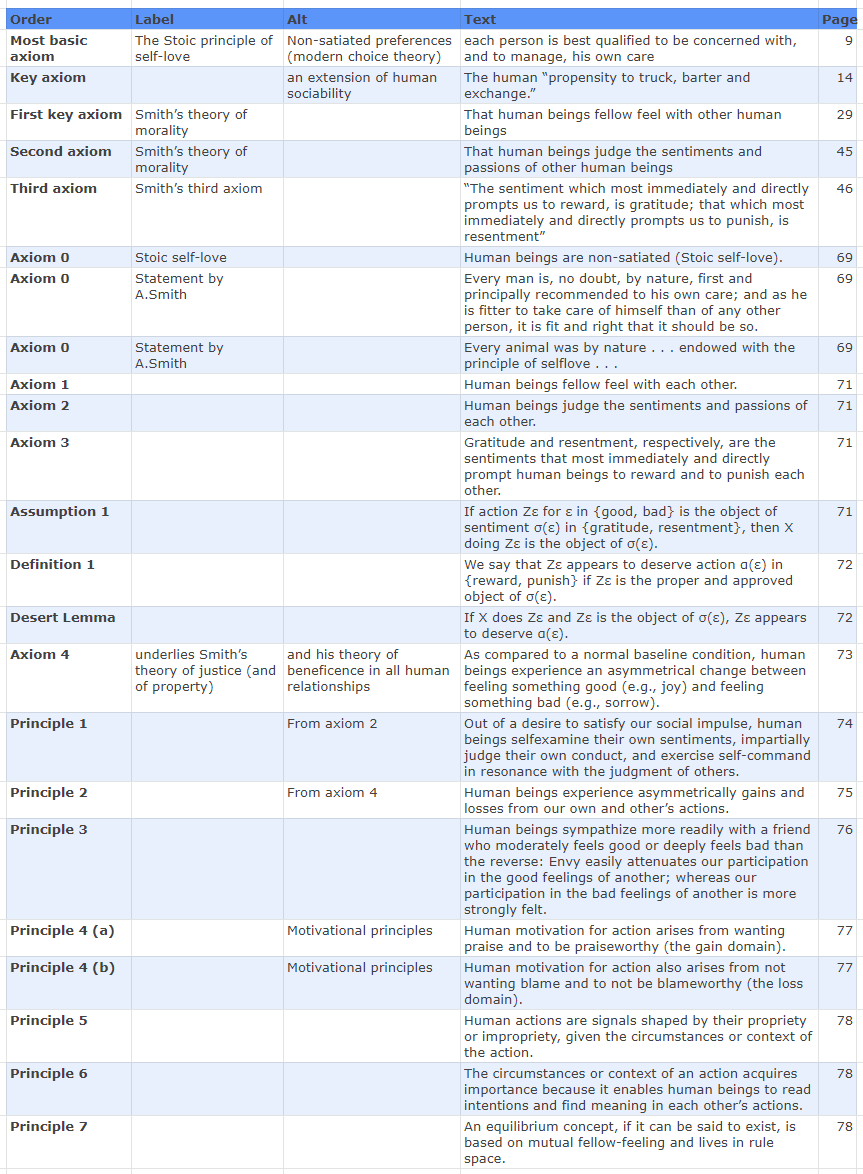
Smith and Wilson coded Adam Smith's ideas in a series of Axioms and Principles, summarized by Leonel Morales, "One aim in restating Smith's propositions as we do is to spell out the simplicity and universality with which he can be read".


Smith and Wilson proceed to analyze some classical games and see how these axioms and principles can explain the results, opposite to the failure of Max-U and behavioral economics. Finally they use Adam Smith's theory to predict the outcome of a new set of games. 

For the authors Adam Smith Theory of Moral Sentiments is a better model to explain how people interact. The analysis also closes the apparent gap between the Theory of Moral Sentiments and the Wealth of Nations. 
"His project in Sentiments is to address how moral conduct emerges out of human interactive experience to form a system of general rules that wisely order society. In Wealth he extends that system to markets and national economy to enable a better understanding of the sources and evolution of the economic order."

Saturday, July 20, 2019

Unschooled

Reading Kerry McDonald's Unschooled reminded me my early years as a parent. Despite not being satisfied with the educational system, we accepted with resignation that we had no option for our kids. We tried to choose the "best" school, however mostly the differences were the quality of the people leading the schools and their teachers. Even a friend tried to convince us to home-school our kids but we felt it was the same (school at home) minus the "socialization". Years later we were invited by another friend to join an alternative school, an off-the-system project. It was a challenge because people around us opposed and voiced their opinions with comments like "you are going to ruin your kids lives", and so. The project was worth, not because of pure opposition to the mainstream, but being off-the-system allowed them to offer a truly student center project with mixed ages, learners community, no-grades, no-homework, etc.

All this process was scary because we had no reference beyond the myth of schooling, the same myth we grew up with and we have survived!!! Was this our tantrum against the system and our kids were going to pay the price? The problems with the traditional schooling and the benefits of these new projects are well supported by theory and scholars yet little evidence was available to confirm that it works in practice. And this is where Unschooled fills the void. Using Kerry's own words 
"Schooling has become so engrained in our culture and conversation that disentangling it from learning takes time and though. Not only do we need to unschool our own thinking but also we need to help others do the same."
Unschooled is McDonald's "personal views and experiences related to unscholling and self-directed education" nonetheless it is very well documented. From John Locke to Peter Gray the breadth of references is a proof of the seriousness of her work. Along the theoretical references Unschooled offers a mosaic of real people's experiences doing what they believe is best for the kids. Unschooling is a movement that has its roots in the progressive reforms of the 1960's, it has reborn with a core difference "one refreshing change with today's unschooling movement is that it is being driven not by philosophers but by parents"

The book covers the history of unschooling, gives a definition and contrast it with schooling, and tackles some myths like; the curriculum, freedom is not license, appropriate ages to learn math or reading, and more. Also the book has a good diagnosis of the problems of the mainstream system and how it has worsen over the years despite efforts to fix it. Kerry McDonald is straight and honest in this respect "what we need conventional public schools to become if they are to truly move from a schooling paradigm to a learning one. They need to be built entirely from scratch."

In a later part of Unschooled, is a section with resources for unschoolers. From technology, resource centers, fab labs, maker spaces, libraries, revolutionary schools, apprenticeships, adventure playgrounds, and more. In summary this section is a window of options and an invitation to join and start a resource for our own communities. 

The last chapter is an outlook of the future of unschooling, which can be summarized in Kerry's call to action: 
"It all comes down to parents. It will be parents who decide whether or not we move toward an unschooled future. It will be parents who determine whether or not to reclaim their child's education."
The only subject I think the Unschooled is missing is the labor markets. As long as companies keep hiring by degree (the sheepskin effect that Brian Caplan describes in his book The Case Against Education) the unschooled future is riskier, specially for lower income families who can't rely on friends, connections, or family safety nets. There is some hope in this regard after some tech giants are dropping the diploma from their hiring process, but it is far from generalized practice. 

If you want to learn more about Kerry McDonald check her blog Whole family learning


Friday, June 21, 2019

Children and Play in the Holocaust

Children and Play in the Holocaust is a emotionally hard to read essay by George Eisen. With a long list of references Eisen presents the experience of children in ghettos, detention centers and concentration camps during the Nazi occupation. These stories challenge the classical theory of play but also reinforce how play is so encoded in our genes that is almost unavoidable. 
"Play burst forth spontaneously and uncontrollably without regard of the external situation."
The sociological, psychological, physiological and even political aspects of life during the Holocaust are visited under the lens of children, and adult, play.
"Their play, just like all human experiences, was reflective of and governed by societal, psychological, and economic conditions of the society in which they took place."

For the people in the play field the book can be used as a catalog of play experiences to be classified under the 16 play types by Bob Hughes; to identify the play cycle and the role of adults in free play.

A River in Darkness

A River in Darkness is a surreal story of a man struggle to survive in North Korea. Half Japanese and half Korean, Masaji Ishikawa migrated to North Korea after his father got enticed by the lies of Kim Il-sung. For 36 years he struggle to survive to care for his family and see them die of starvation and abuse. He finally made it back to Japan just to find indifference and hostility. 

Among the lessons in the book is the eyewitness testimony of the failure of central planning (core of Socialism and Communism)
But that’s the thing. People in North Korea spend so much time in study meetings and calculating the number of hours they’ve worked that there’s no time to do the actual work. The result? Raw materials don’t arrive in factories, the electricity doesn’t work, and farms are overrun with weeds. But as long as people can get their food rations, they don’t care.
The black market was also thriving. It seemed the more messed up a country became, the more the black market prospered.

A River in Darkness is strikingly crude in the recollections of Ishikawa memories but also in the blind eye of other governments that wanted to avoid conflicts with North Korea, specially China and Japan itself. 
I often think about what would have become of me if I’d stayed in North Korea. I would probably have starved too. But at least I’d have died in someone’s arms with my family gathered around me. We’d have said our goodbyes. What chance of that now?
Ishikawa disappeared, don't know if publishing the book helped him in anyway. Don't even know if Masaji Ishikawa is his real name or a pen name. We just can hope he found peace.

Friday, May 4, 2018

Reality Is Broken: Why Games Make Us Better and How They Can Change the World

Reality Is Broken: Why Games Make Us Better and How They Can Change the World Reality Is Broken: Why Games Make Us Better and How They Can Change the World by Jane McGonigal
My rating: 5 of 5 stars

Currently we see everywhere from the news to the dinner table people complaining about video games and screens. What most people don't realize is that video games have been part of life for over 40 years. Many of the ones complaining used to spend hours at arcades or playing with early video consoles. Video games are part of reality and no matter how much we disagree they will not go away anytime soon. According to a Newzoo report "2.2 billion gamers across the globe are expected to generate $108.9 billion in game revenues in 2017".

Jane McGonigal is a game developer who shares her 10+ yrs experience developing video games. She explains how for gamers Reality is Broken because when they contrast their real life (school, work, etc.) and their virtual worlds they find in the later a lot of the values reality no longer provide.
"Gamers want to know: Where, in the real world, is that gamer sense of being fully alive, focused, and engaged in every moment? Where is the gamer feeling of power, heroic purpose, and community? Where are the bursts of exhilarating and creative game accomplishment? Where is the heart-expanding thrill of success and team victory? While gamers may experience these pleasures occasionally in their real lives, they experience them almost constantly when they’re playing their favorite games."
Games have some characteristics that are more or less common. A sense of purpose, a goal. They have rules that define boundaries and within unleash creativity and foster strategic thinking. Games have a feedback system that keep games engaged and motivated. Finally, McGonigal includes voluntary participation that is important for community formation. A fifth characteristic not included in the book is competition. Which is interesting because as later explained in the book, gamers are good at cooperation. Even in games that are about winning gamers find more motivation in collaborative modes.

McGonigal explains how game developers not only are good at games but have a better understanding of positive psychology and human motivation than most reality developers. Schools, companies, communities and even play spaces and parks miss those elements. No wonder when people have a choice digital easily wins.
“Game designers and developers are actively transforming what once was an intuitive art of optimizing human experience into an applied science. And as a result, they are becoming the most talented and powerful happiness engineers on the planet.”
But the most amazing insight is the power of Massive Multiplayer Online (MMO) Role-playing game (RPG). For instance, World of Warcraft gamers had spent over 5.93 million years solving challenges over the first six years. McGonigal proposal is to tap the power of MMO to tackle world problems. Not only local problems but those that require massive efforts such as pandemics, food supply, energy, network security, and migration. Through Alternate Reality Games - ARGs (ARGs are games you play to get more out of your real life, as opposed to games you play to escape it.)" players can bring all the good of video games to the real world.

Throughout the book, Jane McGonigal suggests 14 fixes to reality, in other words; how can we bring the excitement and motivation to our regular lives and more? With ideas such as:
"(Fix #2: Activate extreme positive emotions). That’s why games can put us in a positive mood when everything else fails—when we’re angry, when we’re bored, when we’re anxious, when we’re lonely, when we’re hopeless, or when we’re aimless.” 
“We’ve discovered how game designers help us achieve a state of blissful productivity: with clear, actionable goals and vivid results (Fix #3: Do more satisfying work). We’ve seen how games make failure fun and train us to focus our time and energy on truly attainable goals (Fix #4: Find better hope of success). We’ve seen how they build up our social stamina and provoke us to act in ways that make us more likeable (Fix #5: Strengthen your social connectivity), and how they make our hardest efforts feel truly meaningful, by putting them in a much bigger context (Fix #6: Immerse yourself in epic scale)." 
"We’ve considered how points, levels, and achievements can motivate us to get through the toughest situations and inspire us to work harder to excel at things we already love (Fix #8: Seek meaningful rewards for making a better effort). We’ve looked at how games can be a springboard for community and build our capacity for social participation (Fix #9: Have more fun with strangers). " 
“crowdsourcing games that successfully engage tens of thousands of players in tackling real-world problems for free (Fix #11: Contribute to a sustainable engagement economy).”
Instead of fighting against video games people should learn and incorporate their best practices to life. In addition, this could empower people to collaboratively solve big world problems.


View all my reviews

Wednesday, April 25, 2018

Why Nations Fail: The Origins of Power, Prosperity, and Poverty

Why Nations Fail: The Origins of Power, Prosperity, and Poverty Why Nations Fail: The Origins of Power, Prosperity, and Poverty by Daron Acemoğlu
My rating: 4 of 5 stars

Why Nations Fail is a contribution in the field of Development Economics. Daron Acemoglu and James Robinson elaborate a thesis trying to explain "why some nations are prosperous while others fail and are poor". Their thesis of the difference between extractive and inclusive institutions is intellectually appealing and provides a framework for a analysis of the chances for current states to improve. However they can't explain the emergence of these institutions and concedes that their existence is the fragil product of a Darwinian process.
"However, when a critical junction arrives, these small differences that have emerged as a result of institutional drift may be the small differences that matter in leading otherwise quite similar societies to diverge radically"
There are some fundamental ideas where I disagree with Acemoglu and Robinson. The first is the title itself. For a nation to fail it first had had to succeed. The natural condition of most human societies through history is poverty and some states have thrived and prospered. At present time more and more nations have progress, a shift in history that is not accknowledge in the book. This problem is fundamental because in some of the cases the description is incomplete and inaccurate. For instance what we now know as Perú was better than the north of America 500 years ago. It is correct that the USA is way much better than Perú, and itself 500 years ago; but Perú is also better today than Perú 500 years ago. Perú didn't fail, but it didn't succeed like the USA.
"Peru is so much poorer than Western Europe and the United States today because of its institutions... five hundred years ago the Inca Empire, which occupied contemporary Peru, was richer, more technologically sophisticated, and more politically centralized than the smaller polities occupying North America."
I also find the institutional framework problematic and incomplete. The thesis is that inclusive political institutions and economic institutions are the cause of prosperity. This creates a four state model, being inclusive-inclusive the best and extractive-extractive the worst. Combinations of extractive-inclusive and inclusive-extractive yield mixed results, sometimes short-term prosperity or eventual political collapse. So far the model is OK. If institutions are so important, why didn't Acemoglu deepen in what institutions are important? Maybe because they can't.
"The outcome of political conflict is never certain, en even if in hindsight we see many historical events as inevitable, the path of history is contingent."
It is up to the reader to try to figure out from the cases what common elements may define the correct institutions. On the political side Acemoglu and Robinson favor democracy and not so much rule of law. A unbounded democracy can easily turn into a tyranny of the majority (see following issue). Among the economic institutions they favor private property which is a very static concept and overlooks entrepreneurship and price system.

A third issue is the predictive power of the model. A theory that fits to the past but can't predict to the future is not strong. For instance, Acemoglu and Robinson picture Brazil, after its inclusive democracy, as a success story which is not. Democracy in Brazil switched the balance of power but didn't transform the nature of the institutions. Poor respect for property rights and rule of law left the door open to corruption and populism. The turmoil in Brazil in 2017-18 and many Latin American nations give some hope but reality is that agendas remain populist. The problem with the predictive power of the model is that it has no power.
"extractive institutions can be replaced by inclusive ones. But it is neither automatic nor easy. A confluence of factors,..., is often necessary..... In addition some luck is key, because history always unfolds in a contingent way." (emphasis is mine)
The model of virtuous and vicious circles are easy to agree with Acemoglu and Robinson. They provide an explanation of the inertia that prevents institutional changes and help sustain the status quo, while giving hope for positive change and a warning for the fragility of inclusive nations.
"The synergies between extractive economic and political institutions create a vicious circle, where extractive institutions, once in place, tend to persist. Similarly, there is a virtuous circle associated with inclusive economic and political institutions. But neither the vicious nor the virtuous circle is absolute."
As a friend, Michael Strong, says "given MIT economics' traditional neglect of institutions,... Acemoglu should be regarded as a hero relative to his peers". Overall Acemoglu and Robinson provide a model to build on. Why Nations Fail description of history, although not accurate, is a point of reference to discuss what changes truly make nations prosper.

View all my reviews

Wednesday, November 8, 2017

El Federalista (The Federalist Papers)

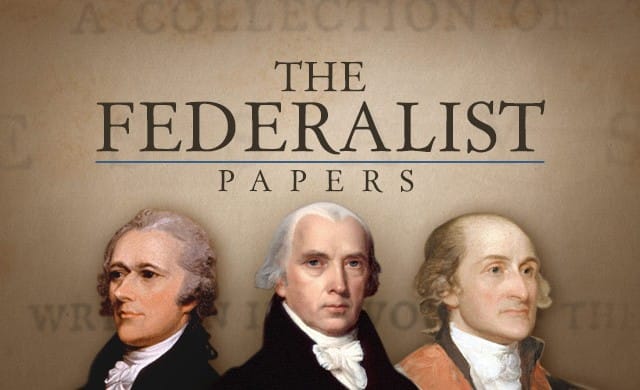
Thomas Jefferson pensaba que los niños debían aprender a leer con libros de Historia. El Federalista o “The Federalist Papers” cómo se les conoce en inglés son una colección de artículos publicados en New York previo a la ratificación de la nueva constitución de EUA en 1789, la mejor y más duradera constitución del mundo moderno. Escritos por James Madison, Alexander Hamilton y John Jay estos artículos explican con claridad el razonamiento detrás de la constitución. Dentro de los artículos los de Madison destacan por su claridad filosófica. Hamilton es hoy más popular y tiene una posición más inclinada a favorecer un gobierno federal fuerte. 

No todas las ideas prosperaron y no todas eran igual de buenas para establecer las bases de una República. Sin embargo, siguiendo el consejo de Jefferson, El Federalista es una lectura obligada hoy que muchos de los valores que la Constitución defienden se han puesto en duda y tergiversado. 

Un buen cierre de la lectura sería la advertencia de Benjamin Franklin cuando le preguntaron que habían hecho “una República si la pueden conservar”

>>>>>>>>>>>>>>>>><<<<<<<<<<<<<<<<<

Thomas Jefferson thought that kids should learn to read reading History books. The Federalist Papers is a collection of articles published in a New York newspaper before the ratification of the US Constitution in 1789, the best and longer lived constitution in the modern world. Written by James Madison, Alexander Hamilton and John Jay this columns explain with clarity the rationale behind the Constitution. Within the articles, Madison's outstand thanks to his philosophical clarity. Hamilton is currently the most popular of the three and has a position more incline in favor of a strong central government.

Not all the proposals thrived and not all were equally good to set the foundation of a Republic. However, following Jefferson's advice, The Federalist Papers are a must read today that many of the values that the Constitution defend are questioned and distorted.

A good closing for the book would be Benjamin Franklin's answer when he was inquired of what they did "A Republic if you can keep"

Monday, October 16, 2017

Vida y mentira de Ernesto Che Guevara

Ante el 50 aniversario de la muerte del Che y el nacimiento de un mito esta biografía revisada de Fernando Díaz Villanueva es muy oportuna. Con "Vida y mentira de Ernesto Che Guevara" Díaz Villanueva contribuye a desenmascarar la imagen fantasiosa del joven revolucionario inmortalizada en la fotografía de Alberto Díaz en camisetas, banderas, tatuajes y más medios de expresión modernos.

Desde el inicio el autor nos advierte el esfuerzo por elaborar un relato objetivo, algo difícil cuando se trata de un tipo que genera muchas emociones de un lado y del otro.


"El Che Guevara merecía ser biografiado, pero no para hablar bien de él, tampoco mal, simplemente para contar su vida de una manera apasionada y escéptica. Eso es, en definitiva, lo que pretende el presente libro."

Mi versión del Che
(hecho con imágenes de dominio púbico)

Creo que Díaz Villanueva con un relato bien hilvanado, con toques de ironía que si no fuera por la seriedad de las historias podría llegar a ser divertido, logra su cometido. Poco a poco la historia desempaca el perfil de un jóven oportunista y acomplejado que se creía más de lo que realmente era, el inconforme que saltando entre la adversidad y la suerte llegó a ser uno de los hombres más nefastos de la historia reciente de América Latina. 


El mito del Che ha multiplicado la malignidad del hombre al justificar las acciones de miles de hombres y mujeres. Ojalá la obra Fernando Díaz Villanueva llegue a las personas, sobre todo jóvenes, que viven en contradicción creyendo que defienden causas justas pero portan logotipos del Che. 

Saturday, July 15, 2017

Deep Thinking


In a world of pessimism a word of optimism is always welcome. This is what Garry Kasparov has to tell in his new book, "Deep Thinking, where machine intelligence ends and human creativity begins".

Garry Kasparov is a Russian born chess world champion and maybe the best grand master in history. After living in the soviet Azerbaijan he and his family escaped during the collapse of the Soviet Union. A democratic leader and opponent to the Putin regime he had to move to the US in 2013. He is the chairman of the Human Rights Foundation and has worked in defense of human rights and freedom for a long time.

This combination of chess master, computer geek and freedom lover permeates in his new book. He is a believer in the potential of humanity under a free systems despite its natural paradoxes.
"Even the most disciplined human mind wanders in the heat of competition. This is both a weakness and a strength of human cognition. Sometimes these undisciplined wanderings only weaken your analysis. Other times they lead to inspiration, to beautiful or paradoxical moves that were not on your initial list of candidates."
In Deep Thinking, Kasparov narrates his experience loosing against Deep Blue, IBM's supercomputer in a chess match in 1997. When a computer beat the world chess champion it became a tipping point for media and the public in the race of machine against humans.  Beyond a historic recollection of the events and some inside details that were not made public back then, Kasparov's book is a call for hope. Having experienced in person the overwhelming brute power of a computer he is not naïve in being optimist.
"Few people in the world know better than I do what it’s like to have your life’s work threatened by a machine. No one was sure what would happen if and when a chess machine beat the world champion."
The main thesis of Kasparov is that we can't know what is going to happen in the future but we should start from accepting that progress is unstoppable and desirable, therefore we shouldn't pretend to defend ourselves by holding it back.
"We don’t get to pick and choose when technological progress stops, or where. Companies are globalized and labor is becoming nearly as fluid as capital. People whose jobs are on the chopping block of automation are afraid that the current wave of tech will impoverish them, but they also depend on the next wave of technology to generate the economic growth that is the only way to create sustainable new jobs. Even if it were possible to mandate slowing down the development and implementation of intelligent machines (how?), it would only ease the pain for a few for a little while and make the situations worse for everyone in the long run."
Instead we should embrace change and formulate tougher and deeper questions. The combination of human creativity and machine brute power is super powerful, instead of fear of Artificial Intelligence - AI (machines replacing humans) we need Intelligence Amplification - IA (machines enhancing humans)
"We aren’t competing against our machines, no matter how many human jobs they can do. We are competing with ourselves to create new challenges and to extend our capabilities and to improve our lives. In turn, these challenges will require even more capable machines and people to build them and train them and maintain them—until we can make machines that do those things too, and the cycle continues. If we feel like we are being surpassed by our own technology it’s because we aren’t pushing ourselves hard enough, aren’t being ambitious enough in our goals and dreams. Instead of worrying about what machines can do, we should worry more about what they still cannot do." 
It is in the proper combination of humans and machines that we can reach our full potential.
"A clever process beat superior knowledge and superior technology. It didn’t render knowledge and technology obsolete, of course, but it illustrated the power of efficiency and coordination to dramatically improve results. I represented my conclusion like this: weak human + machine + better process was superior to a strong computer alone and, more remarkably, superior to a strong human + machine + inferior process."
But Kasparov positive vision has a caveat. It won't occur unless we have ambitious projects to pursuit and make important changes in politics, R&D, international cooperation and education.
"America still possesses the unique potential to innovate on a scale that can push the entire world economy forward. A world in which America is content with mediocrity is, literally, a much poorer world. 
R&D budgets have been slashed over the years as investors take a skeptical view of anything that doesn't feed the bottom line. Government-backed research tends to favor specific budgets to fit an existing need, not ambitious, open-ended mission to answer big questions. 
Trade wars and restrictive immigration regulations will limit America’s ability to attract the best and brightest minds, minds needed for this and every forthcoming Sputnik moment.
That our classrooms still mostly look like they did a hundred years ago isn’t quaint; it’s absurd. How can a teacher or even a stack of books be the sole source of information for kids who can access the sum of all human knowledge in seconds from a device in their pockets."
Kasparov's book is recommended to those worried about the future. I rate 4 stars because the book is a little repetitive and circular which makes the message less powerful and the reading a little weary.

As an additional reference, Tyler Cowen made an interesting interview to Garry Kasparov short ago(see transcript here) here is the audio.

Sunday, June 26, 2016

A Brief History of Entrepreneurship

Joe Carlen book is History the way I wish I had in school. Instead of the disconnected list of events "A brief history of entrepreneurship" is a dynamic summary of human history since the first civilizations in Mesopotamia until the next frontier out of our planet, from the eyes of entrepreneurs and those pushing out the boundaries of the then current world.
"The transformation from rural agrarian to urban commerce took place during the Uruk period of Sumerian history, an era that began about 3,500 years ago."
The narrative of the book allows the reader to identify the birth of institutions we take for granted today. From the division of labor, the non-zero sum trade, financial instruments to fund explorations, the early corporation and merchant societies, accounting control, fiat money, etc. 


The book is mainly descriptive and not normative about entrepreneurship but it is easy to identify historic patterns. Carlen's sources make the book credible and a good reference to understand the systemic differences of motives and results. In periods like the early Sumerians and Phoenicians dominated more by City-States that had high commercial interaction progress excelled. In contrast periods with strong centralized governments like Romans and Medieval times the entrepreneurial spirit was limited to cronyism and corruption. No wonder why in the first kind entrepreneurs and merchants were in high esteem, while in the later were the lowest of the classes.

Chapter 4, An Enterprising Faith, is quite interesting under the light of the current geopolitical events. It describes the emergence and advancement of the Arab world in the VII century. Unified under Muhammad the Arabs expansion covered the Middle East, North Africa/Spain and parts of Central Asia. Despite it was a military conquest it was driven by mercantile concerns. The Muslim world was a remarkable pollinator. It expanded and advanced Greek scientific knowledge, made mathematical contributions like algebra, expansion of use of writing paper from China, silk, cotton, wool textiles from different regions, or African Coffee.

The Brief history has a space for Sumerians, Phoenicians, Egyptians, Greeks, Romans, Arabs, Chinese, Mongols, Western Europeans and their Imperial expansion to America, Africa, India and Asia, and the Colonist. Before the Industrial Revolution most of the benefits of the entrepreneurial spirit were limited to the regions that were thriving and not globally. The last part starts with the Industrial Revolution. Carlen misses the role of ideas in the change of pace of progress, something that Deirdre McCloskey brilliantly explains. Nonetheless he points out:
"However, prior to the Industrial Revolution, innovation in the form of disciplined scientific inquiry rarely intersected directly with the world of entrepreneurship. The original Industrial Revolution, that is, the one that occurred in Britain and peaked during the seventy-year period of 1760-1830, is when those worlds coalesced in unprecedented ways."

Carlen covers the modern era with short biographies of business tycoons from Abraham Darby (1678-1717) to today pioneers of the last frontier like Elon Musk, Jeff Bezos and Richard Branson. Including people like James Watt, Thomas Edison, the wrongly called Robber Barrons (check Andrew Bernstein's "The Capitalist Manifesto"), entrepreneurs in different parts of the world (China, Latin America, Africa, or Russia), the information revolution with Bill Gates, Steve Jobs and more.

Overall the "A Brief History of Entrepreneurship" is a good reference of how entrepreneurship and human progress go hand in hand. A window of the conditions that allow these ever present minds shine and make all our lives better.

My rating 4 stars.


Sunday, December 6, 2015

Omnipotent Government

Ludwin Von Mises wrote Omnipotent Government in 1944 at the last days of WWII. Mises describes the philosophical grounds of the Nazi movement. A book rich in history background and a though provoking plan for the future.

In the first part Mises explains the German Liberalism during the middle of the XIX when the ideas of the classical Liberalism were partially adopted in Germany. According to Mises:
"At about the middle of the nineteenth century those Germans interested in political issues were united in their adherence to liberalism. Yet the German nation did not succeed in shaking off the yoke of absolutism and in establishing democracy and parliamentary government."
Mises explains the history of Germany from the late XVIII to the early XX with a different point of view from the dominant Socialist Historians. Overall he shows how and why a powerful-educated German society fell into Nazism.
"The questions to be answered are not: Why did the bankers and the rich entrepreneurs and capitalists desert liberalism? Why did the professors, the doctors, and the lawyers not erect barricades? We must rather ask: Why did the German nation return to the Reichstag members who did not abolish absolutism? Why was the army, formed for a great part of men who voted the socialist or the Catholic ticket, unconditionally loyal to its commanders? Why could the antiliberal parties, foremost among them the Social Democrats, collect many millions of votes while the groups which remained faithful to the principles of liberalism lost more and more popular support? Why did the millions of socialist voters who indulged in revolutionary babble acquiesce in the rule of princes and courts?"
For Mises the German Liberals were unable to protect the principles and ideas that help them succeed. They saw Socialism and Nazism as temporary setbacks and never recognize the deep roots of Etatism. Soon Etatism armed with a strong military evolved into nationalism.
"As soon as liberalism reached Germany and Italy the problem of the extent of the state and its boundaries was raised. It solution seemed easy. The nation is the community of all people speaking the same language; the state's frontiers should coincide with the linguistic demarcations."
"The principle of nationality is an outcome of the interpretation which people in Central and Eastern Europe, who never fully grasped the meaning of liberal ideas, gave to the principle of self-determination. It is a distortion, not a perfection, of liberal thought."
The nationalism originally define as unity of language evolved  to unity of race. The idea that Germany was the strongest among European nations contrasted with the defeat after WWI and the unacceptable conditions of the Versailles Treaty. It fueled the legend of "the stab in the back" followed by the total failure of the Weimar Republic setting the conditions to the advent of Nazism. The party sold itself as the enemy of the communist to the liberals and as saver of the poor from the bourgeois. But overall a saver of the German Nationalism, nationalism now defined by race with a common enemy, Jews.

Mises' conclusion can be read two ways. Considering the era when The Omnipotent Government was published he recognize the improbability of a liberal world, necessary to discard aggression from other countries, plus the risk of government to close their borders establishing autarkic states and starting aggression against their neighbors to eliminate its dependency. 
"But will all men rightly understand their own interests? What if they do not? This is the weak point in the liberal plea for a free world of peaceful coöperation. The realization of the liberal plan is impossible because—at least for our time—people lack the mental ability to absorb the principles of sound economics. Most men are too dull to follow complicated chains of reasoning. Liberalism failed because the intellectual capacities of the immense majority were insufficient for the task of comprehension."
But sixty years later we can read his conclusion as a kind of prophecy of how humanity is condemned to live with the risk of war supporting strong armies as long as the different flavors of etatism are not replaced by liberalism, where goods and people move freely anywhere in the world.

Is capitalism an all or nothing global condition for peace? Are global coalitions and governments the only defense to totalitarian neighbors?

This book was the subject of the 2015 Socialism Seminar organized by the Center for the Study of Capitalism at Universidad Francisco Marroquin.

My rating 4 out of 5.


Tuesday, September 29, 2015

Las Tribus Liberales


Las Tribus Liberales es una narrativa de María Blanco (@Godivaciones) sobre su recorrido liberal visto desde diferentes perspectivas. De una manera creativa María utiliza las figuras de la mitología griega para describir las ideas de la libertad en el mundo actual.

Como sabiamente aclara al inicio "es una perspectiva personal, hablo más de quien conozco más y de quien más me gusta a mí... Mi pretensión no es ser exhaustiva sino dar mi punto de vista honestamente y con toda humildad."

En efecto el libro es casi una conversación con la autora que descubre las bases del liberalismo, las disputas entre liberales, las críticas a los liberales, y en general las esperanza que algún día el ciudadano entienda las diferencias de la libertad individual sobre los chantajes estatistas e irracionales.

El libro se divide en cuatro partes cada una identificada con iconos de la mitología griega. La primera parte, Atenas, explica la origen histórica del liberalismo y sus diferentes variantes. Evolución tanto en el entorno puramente académico como en grupos de pensamiento y sus partidarios.

La segunda parte dedicada a Eris descubre la lucha política entre diferentes actores, muchos de ellos que toman elementos liberales a conveniencia. María critica la defensa pragmática del liberalismo porque primero que nada no tiene un fundamento de ideas sólidas que trasciendan las circunstancias del momento, y por otro lado la realidad desnuda los esfuerzos pragmáticos porque lejos de ganar terreno se ha perdido a costa de la credibilidad de las ideas.
"Están firmemente convencidos de que es mejor ceder a las políticas socialistas a cambio de aplicar alguna medida liberal. En lo que ha derivado esta idea que, en principio, puede parecer sensata, es que se ha cedido tanto a las medidas socialistas a cambio de un tímido soplo de liberalismo en algún aspecto menor, que el remedio ha sido peor que la enfermedad y el mal realizado se ha multiplicado. Por un lado no hay verdaderas medidas políticas liberales, y por otro, de tanto mentar el supuesto liberalismo, la gente de la calle lo identifica con ese híbrido burdo y dañino."
Posteriormente entra a abordar la relación de los liberales con el ciudadano. En esta parte María es crítica de las discusiones académicas, rebuscadas e insensatas. Para la gente en la calle, el debate liberal pasa a ser un espectáculo de gente rara. Para mientras se entregan a las arbitrariedades de los gobiernos.
"Esta creación de una realidad por parte de los medios tiene como resultado la formación de una masa de población conformista e incapacitada, como un niño, un menor de edad que ha de estar representado por un adulto. Así también, nuestra sociedad está tutelada por el Estado."
Finalmente María baja al reino de Hades y rebate algunas de la criticas más comunes, pero no por ello sustentadas, al liberalismo. Desde el favoritismo de los ricos, la liberación de las drogas, el trabajo infantil, y más. Una a una expone los argumentos de los críticos y presenta una defensa basada en principios, distanciada de pragmatismos que no son extraños en otros liberales. 

En resumen, el libro es una texto para la gente que está en medio de este universo caótico de las ideas; entre escuelas, autores, políticos y esperanzas. La gente al final busca vivir mejor, ojalá aportes como este logre que cada día sean más los que entiendan que solo la defensa de la libertad individual provee los medios para ello.


Tuesday, March 12, 2013

Law and Revolution


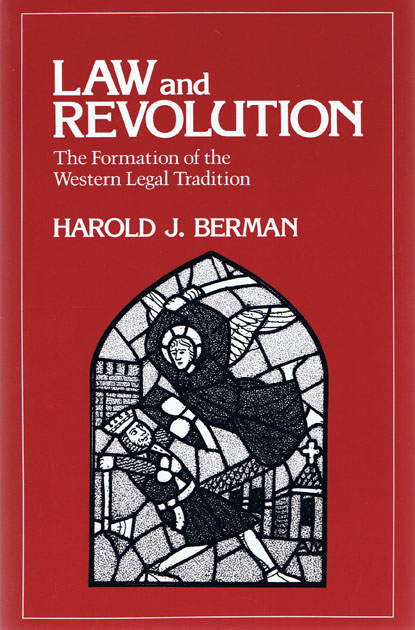
Harold J. Berman thesis presents how the seeds of the Enlightenment, the Industrial Revolution and the Capitalist society were planted in the Middle Ages after the Papal Revolution. By elaborating on the the parallels of different kingdoms after the Papal Revolution he shows in Law and Revolution how they built upon the experience of the establishment of the Church as a State. The rivalry between the Pope and the King, the interrelationship between different kingdoms, and the mobility of people and goods help to spread the systemic view of the Law as a tool for management of societies.

Berman thesis opens a lot of questions. For instance. Is it possible for other traditions to adopt the benefits of the Western Traditions considering that they didn't go through such long and evolutionary process? Is the traditional misconception of the origins of the western tradition a source of conflict with other parts of the world? Is the Legal tradition actually a sound foundation for the construction of better societies instead of the result of other causes like Economic Progress or Political Freedom?

My rating: 4 of 5 stars