Tuesday, May 13, 2014

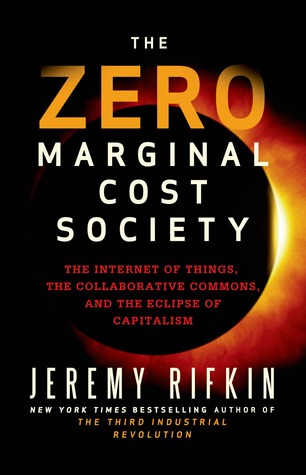
The Zero Marginal Cost Society

Interesting question with an ignorant answer.

The first part of The Zero Marginal Cost Society  is quite interesting. Indeed it is intriguing that so many industries are rapidly growing offering free or almost free products and services. How can an economy sustain if this phenomena advances.

More and more people can set their conditions about job and companies, they no longer are job takers and employees for life. Probably this is possible because people in advanced societies don't have to worry about where to live, what to wear, or what to eat. As Maslow and others have suggested once basic needs are covered without uncertainty people can focus more on higher order ones.

So far, Jeremy Rifkin presents an intellectual challenge. Artist giving away their job, free Education in MOOCs, Open Source software, etc.

In the second part Rifkin addresses the causes and obstacles and here I found way too many contradictions, misrepresentation of ideas like Capitalism and biased solutions. For instance Rifkin criticize the patent granted to genome labs and their market drive. Yet later he praises how low cost has ADN sequencing became.

Rifkin calls for the abolition of private property while promotes collaboration. How can someone collaborate in society if that person has nothing to offer, a private asset? For instance he mentions shared spare rooms as an alternative to expensive hotels. How can someone share a room of someone else? Or is someone really collaborating by offering a communal room?

Another subject that Rifkin elaborates is the idea of the Commons. He uses Orstrom's theory but misses the point that the commons need a ground of trust and supervision. How can such model become a world wide system is not answered and seems unbelievable.

As Ludwing Von Mises proved many years ago, Socialism is impossible without the economic calculation, specially on the means of production. In Rifkin's world the private property of means of production disappears. How can production be prioritized, who will give maintenance to the huge capital investments that allow the high productivity needed to achieve near zero marginal cost? how innovation will be sustained? None of these are addressed in the book.

Finally I would say that Rifkin identified how many of the cases he states as outliers are indeed reactions to the burden of government regulations and controls. From medicine, to building, energy, transportation, etc. in most of his cases the adversary is some form of government regulation, privilege, etc. Rifkin acknowledges the evil in government actions. Yet his conclusion is to give more power to governments instead of more private solutions.

In summary Rifkin's ideas can be summarized as "Don't bite the hand that feeds you".

My rating: 3 of 5 stars

Monday, May 5, 2014

Mindset: The New Psychology Of Success

Mindset: The New Psychology Of Success
Carol Dweck work proposes a theory of the difference between those who succeed and those who didn't. As the title of the book reveals it is all about Mindset. Dweck work is interesting, not sure of how scientifically thorough since the book is mainly anecdotal, yet his theory makes perfect sense and is easy to relate to personal life.

After covering the the ground for her theory, Dweck offers specific advice for sports, business, personal relationships, teachers and parents, and individuals. Her ideas are easy to understand, somehow difficult to implement since they require a change of habits, and worth trying.

Dweck ideas complement other frameworks like Angela Dockworth and Paul Tough on Grit and others on Resilience.

My rating: 4 of 5 stars

Saturday, April 12, 2014

The Capitalist and the Entrepreneur

Sometimes when I read entrepreneurial theories I wonder if academics speak to real entrepreneurs. Peter Klein book hit the nail in the head, from my personal experience in business. He explains the role of the entrepreneur and the markets, and why only a free system is fertile soil for entrepreneurial ventures to create real growth for society.

The Capitalist and the Entrepreneur is also relevant as it explains with great detail the principles and differences in the Austrian School of Economics. With plenty footnotes to guide the readers interest to deepen in this school of thought Klein discusses why Austrian ideas about the price theory, the role of capital allocation, etc. divert from mainstream economics that reduce the entrepreneur and the firm to an abstract black box. Using the ideas of the AE Klein portraits a dynamic and living organization with the entrepreneur, managers, people and resources.

Since the interest on entrepreneurship is on the rise, Klein's book should go hand in the promotion of these ideas.

My rating: 4 of 5 stars

Tuesday, March 11, 2014

Delusions of Power

Delusions of Power: New Explorations of the State, War, and Economy
In this book Robert Higgs summarizes his ideas on why we have to challenge the existence of government. One by one he knocks down, as dominoes, the rationalization to preserve government. 

Many people can't imagine a world without government because we were raise, by government, to believe it is a necessary institution. If humans had the creativity to create governments, we have so to create its substitute. Innovation has being restrained by the straw man discourse from governments. Like Dickens' Emperor Clothes we are reluctant to see, and Higgs does a great job in opening our eyes to understand that a world without government (as we know it) is not the same as a world of chaos.

Delusions of Power: New Explorations of the State, War, and Economy is a relevant book in the current political arena where parties keep up with the enchanting promises and people keep up believing in them.

My rating: 4 of 5 stars

Monday, February 10, 2014

Madmen, Intellectuals, and Academic Scribblers:


Wayne Leighton and Ed Lopez present in Madmen, Intellectuals and Academic Scribblers an interesting interpretation of the dynamic of regulations. Beginning with a clear fast forward history of philosophy they set the ground to present their model. Overall the book builds on Public Choice ideas adding the perspective of the entrepreneur of ideas. Contrary to common belief that ideas change only through crisis and revolutions, Leighton and Lopez explain the role of the Entrepreneurs of Ideas. If institutions are sound there is no need to revolutions, just a dynamic that resembles the spontaneous order in a market of ideas.

Each one of the roles act at different levels in society affecting the probabilities of ideas to win in the market. Each actor adequate the message to a different audience from the one who generate the ideas to the people who vote for them in the democratic game.


The book left me thinking on what was behind the scenes of current policies and regulations, and what new ones are in the making.

Friday, January 17, 2014

The Forgotten Man

It is a common believe that you can boil a frog to dead. Truth or not it is my impression of what happened to the USA founded by Thomas Jefferson and the rest of the Founding Fathers. The USA today, and most of the western world, is far from the country build in the late XVIII century.

I always wonder how such change could be permitted. Amity Shlaes fill a big part of the puzzle by vividly describing the Roosevelth era. He and his Stalin captivated socialist intellectuals were not a progressive but disruptive force. Much of the big changes in government role began during this years.

The Forgotten Man is an important reading for all who are concerned with the present times. A call to action to fight for Freedom and its principles. Pres. Obama is FDR reloaded and I hope that in 70 years we won't be reading the book "You didn't build it" describing the last stroke of socialism over the free world.

Shales made an excellent job reenacting this inflection time in history.

My rating: 5 of 5 stars

Sunday, September 8, 2013

The Capitalist Manifesto


I mostly enjoyed Andy Bernstein well supported case in defense of the Creative Minds and the Inventive Period. History has condemned the most productive minds of the XIX century. As humans, they were not perfect but sure were no "Robber Barons". As productive geniuses we should take their example of the only proven way to quickly improve living standards for all. 

The Capitalist Manifesto uses the Inventive Period and its creative minds as an historic framework to explain the philosophical virtues of Capitalism. A typical error that Andy addresses here is the temptation to compare life in the late XVIII to XIX to the present. People didn't have the choice of the down of the Industrial Revolution and today standard of living, their choice was a miserably poor life in the countryside. People migrated because the conditions were much better than their alternative. Current conditions are the result of the accumulation of Capital that started almost three hundred years ago.

Highly recommended book for those in need of arguments to defend freedom from the its enemies.