Showing posts with label Leadership. Show all posts

Wednesday, October 23, 2019

The Relationship Economy

The Relationship Economy is an interesting book, nonetheless a mix of Customer Service ideas and DiJulius Group advertising. 

DiJulius highlights the importance of customer relationship in all facets of business; customers, employees, leadership,  human interaction in general.

Some ideas worth highlighting are the importance of service as a true differentiation factor. Most vendors of any product or service meet pretty well the requirements of the market, hence what becomes the true loyalty driver is service. 
"Customer Loyalty is a result of the multiple micro-experiences a person has with a brand. It reflects the fact that not only is that business consistently brilliant a the basics, but also that it has taught all its employees to be present in the moment at each of its touch points." 

Another one is the FORD (Family, Occupation, Recreation, Dreams) technique as a tool to foster relationships.  "FORD represents people's hot buttons, what each individual cares about the most. FORD is what they are passionate about. It is the topics that make them light up."

A corollary of the FORD technique is accepting Kalina Silverman   invitation to skip the Small Talk for the Big Talk to connect with anyone. 

Some closing remarks worth sharing: "World-class service is not something you do or deliver; it is something that is in you, in all areas of your life".

Wednesday, November 8, 2017

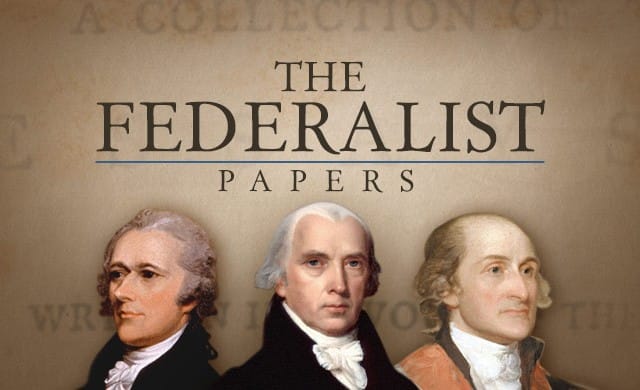
El Federalista (The Federalist Papers)

Thomas Jefferson pensaba que los niños debían aprender a leer con libros de Historia. El Federalista o “The Federalist Papers” cómo se les conoce en inglés son una colección de artículos publicados en New York previo a la ratificación de la nueva constitución de EUA en 1789, la mejor y más duradera constitución del mundo moderno. Escritos por James Madison, Alexander Hamilton y John Jay estos artículos explican con claridad el razonamiento detrás de la constitución. Dentro de los artículos los de Madison destacan por su claridad filosófica. Hamilton es hoy más popular y tiene una posición más inclinada a favorecer un gobierno federal fuerte. 

No todas las ideas prosperaron y no todas eran igual de buenas para establecer las bases de una República. Sin embargo, siguiendo el consejo de Jefferson, El Federalista es una lectura obligada hoy que muchos de los valores que la Constitución defienden se han puesto en duda y tergiversado. 

Un buen cierre de la lectura sería la advertencia de Benjamin Franklin cuando le preguntaron que habían hecho “una República si la pueden conservar”

>>>>>>>>>>>>>>>>><<<<<<<<<<<<<<<<<

Thomas Jefferson thought that kids should learn to read reading History books. The Federalist Papers is a collection of articles published in a New York newspaper before the ratification of the US Constitution in 1789, the best and longer lived constitution in the modern world. Written by James Madison, Alexander Hamilton and John Jay this columns explain with clarity the rationale behind the Constitution. Within the articles, Madison's outstand thanks to his philosophical clarity. Hamilton is currently the most popular of the three and has a position more incline in favor of a strong central government.

Not all the proposals thrived and not all were equally good to set the foundation of a Republic. However, following Jefferson's advice, The Federalist Papers are a must read today that many of the values that the Constitution defend are questioned and distorted.

A good closing for the book would be Benjamin Franklin's answer when he was inquired of what they did "A Republic if you can keep"

Wednesday, March 29, 2017

Shoe Dog

Bill Gates recommended Phil Knight's book Shoe Dog in his 2015 annual blog. After reading Knight's story I can't but agree with Gates.

Shoe Dog is a very honest memoir of Knight and Nike (NYSE:NKE), full of business wisdom but also the challenges and setbacks. He didn't sugarcoated his story like many entrepreneurial books. Reading Shoe Dog is an emotional rollercoaster, from stories of adventure, success, failure, doubts, despair, sorrow, pride and joy.

Things I found amazing about Phil Knight:
  1. He prepared ahead for the adventure. From the very early pages he tells the story of how he wanted to travel around the world. With near $0 budget yet "I spent weeks, reading, planning, preparing for my trip." similar stories are prefaces to his first trip to Japan, to Taiwan and China. 
  2. He cared for his team, having hired very odd people at the beginning mainly trying to help them to his support for the athletes they sponsored.
  3. He recognized his business journey very honestly, from making money, to dominate the market to contribute to the human drama. "I redefined winning, expanded it beyond my original definition of not losing, of merely staying alive. That was no longer enough to sustain me, or my company. We wanted, as all great businesses do, to create, to contribute, and we dared to say so aloud."
  4. His almost devotion to his coach and cofounder, Bill Bowerman, as well as to other people who contribute to Nike success. Constantly not letting Bowerman behind, naming the buildings after supporters, his appreciation for Tiger Woods, etc. 
  5. His connection with his family could be omitted but it helps to appreciate Knight's humanity. The struggle between a growing business and his family, his regret for not having spend enough time with his kids, his apologies to his wife, Penny, for having to waited and waited, 

The book has some pearls of business wisdom too, not as a recipe but as a testimony.
  1. Cash management is crucial specially for a fast growing business.
  2. Plans have a short life, specially when conditions change.
  3. Tell people what you want and let them surprise you with their results
  4. When you believe in something being stubborn pays off, but if you have doubts trust your team.
  5. An IPO may be necessary but the timing is important.
For those interested in entrepreneurship this book is a must. 

An interesting conversation with HBR Ideacast.


Monday, June 27, 2016

The Last Lecture

On September 18th, 2007 Randy Pausch delivered a unique lecture. For years Carnegie Mellon had a series of lectures titled "The Last Lecture" where professors spoke as if it were their last lecture about their personal and professional journeys. In the case of Randy it was indeed his last lecture. Diagnosed the previous summer with pancreatic cancer he had just a few months ahead to live. Instead of lamenting and feeling defeated he dedicated his last months to enjoy life and his family. The father of three small children (Dylan 6, Logan 3, and Chloe 18 months) and married to Jai for eight years, his lecture and book are statement for them and we, as audience, have the privilege to learn from it.

Professionally, Randy Pausch was a computer scientist from Brown University, PhD and Professor from Carnegie Mellon, pioneer in virtual reality and Walt Disney Imagineer, above all an educator.

His lecture "Achieving Your Childhood Dreams" became an instant hit (as of today more than 18 million views in YouTube). After this lecture Pausch wrote the book with more details about his story. The Last Lecture is an autobiography full of inspiring lessons. 


Preparing the lecture Randy struggle with what made him unique. After playing with ideas and memories he conclude that he achieved all his childhood dreams, therefore the title.

The book is broadly divided in three sections. First he shares his childhood dreams and how they were achieved. The lessons are of passion, perseverance, faith and hard work. The second part is a series of anecdotes that give the reader an idea of who Randy Pausch was; an optimist, hard working nerd, passionate about whatever he was involved in (learning, teaching, working, in his marriage, parenting, etc). The last part relates to his values and beliefs. Randy appreciated the community and helping others to achieve their own dreams, family, generosity in general, hard work, frugality, team work, truthfulness, industriousness, and more. 

Randy passed away just 10 months after his "Last Lecture" but his inspiration will remain for many years later.

From USA Today Obituary
Randy Pausch (Oct. 23, 1960 - July 25, 2008)

My rating 4 stars.

Wednesday, September 16, 2015

Unleash Your Inner Company

As times turn harder more and more people are considering starting their own businesses, Unleash Your Inner Company is a timely contribution and a required read for those serious about it.

In Unleash your Inner Company the successful entrepreneur John Chisholm (@johndchisholm) shares his experience to all those who want to be entrepreneurs as well.

John's book is easy to read, fun to follow and provides very useful training. He lays out a 10 step process to think, organize and make your ideas coherent. Beginning from the more simple but fundamental question of what you love and what you are good for, up to creating a full strategy with pricing, differentiation, escalation, financials, etc. The road map works like a blueprint, to build from the ground up, from the basics to the complex. In addition to the framework itself, John takes the reader by the hand clarifying his ideas with examples (some from his personal experience, others are made up yet very concise), suggesting exercises to put the concepts into practice, and FAQ's sections that expand each step further. At the end of each step a short recap becomes a cheat sheet of lessons learned.

In addition to his model, John introduces basic but powerful economic concepts to the entrepreneur. Sort of a reality check for the entrepreneur to be aware of non-business related challenges. Among these ideas we find the importance of institutions to create the environment for ideas to flourish, the damaging effects of centrally controlled regulations on innovation, and the ethics of entrepreneurship as a value creating endeavor.

In the last sections of the book, John adds some useful tools such as 101 accounting, and the relationship of his 10-step model and the popular Business Model Canvas.

John explains that he took the challenge of writing this book after he presented at TEDxUFM in 2011. It is a satisfaction to see an idea materialize. Bellow is an interview given during his visit to Universidad Francisco Marroquin for the event.


My rating 5 stars

Friday, July 17, 2015

Creative Schools

Sir Ken Robinson is one of the leading authorities in Education Reform. His TED talk about how schools kill creativity has been seen more than 30 million times becoming the most -viewed speaker on TED.com. His previous books are also best sellers and though provoking.

In Creative Schools, he makes a thorough diagnosis of the Education Crisis in the world and builds from success stories a proposal for School reform. 

Beginning with the needs of the world as the Industrial Revolution spanned attracting unskilled workers from the countryside to fulfill the jobs, to governments taking control all over the world, centrally planned educational systems are the norm today. 
Wherever you look, education is high on the agenda of governments around the globe. 
These days, governments scrutinize each other's education systems as earnestly as their defense policies.
On-going efforts to improve the system have failed again and again because they are more of the same without addressing the core of the problem. According to Robinson one of these key premises is that education is more than a linear system with simple causal relationships. 
The principle of linearity works well for manufacturing; it doesn't for people.
I said that education is best seen not as an industrial system but as an organic one. More specifically. it is what is know as a "complex, adaptive system"
The importance of education is indisputable yet Sir Ken Robinson makes it explicit to support his opinion about curriculum, assessment (evaluation), teachers and schools, kids and families.
The aims of education are to enable students to understand the world around them and the talents within them so that they can become fulfilled individuals and active compassionate citizens.
The four basic purposes of education: economic, cultural, social and personal
A Hayekian explanation to how the system actually works builds on multiple success stories. Diverse cases that go from his own experience, to Sergio Juárez Correa in Mexico, to Eric Mazur in Harvard, to Salman Khan and Khan Academy, to Sugata Mitra and the School in the Cloud, to Logan LaPlante and homeschooling, to cases in New Zealand, Argentina, and more, give hope to the feasibility of change. 
All living systems have a tendency to develop new characteristics in response to changing circumstances. They may have "emergent features," through "the interaction of small elements forming together to make a larger one. In education, there's an abundance of emergent features right now that are changing the context in which schools work and the cultures within them.
Robinson believes in local solutions; the subtitle of the book is The grassroots revolution that's transforming Education, Nonetheless he equals private initiatives with market solutions (commercial ventures are just one kind, many are non-profit or small local projects) and still hopes that policymakers will be able to lead the revolution. 
In some respects, mass education is, and always was, a process of social engineering. Sometimes the political intentions have been benign and sometimes not. 
Yet his invitation is to take a leading role in changing the status quo. We need multiple projects not just a substitute. Trying different alternatives may offer multiple solutions to the diverse needs of the people while helping future generations thrive in their live.
The revolution I'm advocating is based on different principles from those of the standard movement. It is based on a belief in the value of the individual, the right to self-determination, our potential to evolve and live a fulfilled life, and the importance of civic responsibility and respect for others.
Politicians and bureaucrats are interest groups who will not surrender power easily. Robinson's proposal is more pragmatic involving them in the solution and may be closer to achieve something than more radical solutions. I'm skeptical of anything that has government behind its name but hope that with Sir Ken Robinson's influence some changes will start to occur. 

My rating 4 stars.


Sunday, July 12, 2015

Zen in the Martial Arts

This short book by Joe Hyams is a recollection of stories in his journey as martial artist. Hyams was a Hollywood reporter and writer who started in martial arts in his 30'. He had the opportunity to learn Kempo, Jeet Kune Do, Wing Chun, Hapkido, Aikido, from big masters like Bruce Lee, Ed Parker, Bong Soo Han, and Jim Lau.  

Zen in the Martial Arts is not a book about Martial Arts nor a book about Zen philosophy is a story of self discovery, and how their application can help control ones mind to achieve great results in life.
"this is a book from which readers may learn to apply the principles of Zen, as reflected in the martial arts, to their lives and thus open up a potential source of inner strength they may never have dreamt they possessed."
I stumble upon Hyams book looking for a quote by Bruce Lee who was one of the his master teachers. 
"You will never learn anything new unless your are ready to accept yourself with your limitations. You must accept the fact that you are capable, in some directions and limited in others, and you must develop your capabilities"
A conclusion of Zen in the Martial Arts is that you don't need Martial Arts to understand and appreciate Zen teachings about mind and self control, yet not because you practice Martial Arts you will learn Zen. Anyone can master the techniques yet just those willing to think, feel and appreciate the tradition will grasp the millennial teaching of the masters.
"it is possible to master the physical techniques of the martial arts without understanding or absorbing the spiritual and philosophical basis of the arts. On the other hand, it is also possible to apply the spiritual precepts of Zen in the martial arts without involving oneself in the arts."
Powerful inspiring pearls of wisdom like "Seize life at the moment", but not deep in philosophy.

After finishing the book I felt a urge to return to my practice with a different mindset.

My rating 3 stars.

Tuesday, June 30, 2015

Tao Te Ching

Lao Tsu (also know as Lao Tse or Laozi) was a Chinese philosopher during the 6th Century B.C. Despite some controversy over his existence, his contribution to the Chinese and World Philosophy is undeniable.

The Tao Te Ching, also know as Daodejin, is a book of 81 chapters organized in two books. The name approximate translation is "The Classic of the Virtuous Way". Next to the Bible it is the most translated work of literature. Tao Te Ching is not free of polemic. It is know from copies and chronicles of later writers, and biographers, who tell different stories or arrange the chapters differently. There is even a relevant debate about his influence over Confucius.  Nonetheless this book is a masterpiece of world literature. 

Valuable teachings from The Tao Te Ching are relevant personally, as well as for governments and leaders.

Personally I found lessons of austerity and frugality very though provoking.
But I have three precious things which I prize and hold fast. The first is gentleness; the second is economy; and the third is shrinking from taking precedence of others.
It is better to leave a vessel unfilled, than to attempt to carry it when it is full. If you keep feeling a point that has been sharpened, the point cannot long preserve its sharpness. When gold and jade fill the hall, their possessor cannot keep them safe. When wealth and honours lead to arrogancy, this brings its evil on itself. When the work is done, and one's name is becoming distinguished, to withdraw into obscurity is the way of Heaven.
The highest excellence is like (that of) water. The excellence of water appears in its benefiting all things, and in its occupying, without striving (to the contrary), the low place which all men dislike. Hence (its way) is near to (that of) the Tao.
The analogy with water was popularized by Bruce Lee


Another area of wisdom refers to how the world works and evolves. Similar to much later teachings of Michael Polanyi, F.A. Hayek or the different schools of System Dynamics, Lao Tzu explains the value of spontaneous order when he explains that the Tao precedes even the Gods because the constant is change.
The Tao that can be described is not the enduring and unchanging Tao. 
The work is done, but how no one can see; 'Tis this that makes the power not cease to be.
Movement is a necessary condition for change. Let movement go on, and the condition of rest will gradually arise.
However the key lessons relates to government are as relevant today as in the Ancient times. No wonder why Murray Rothbard considered Lao Tzu the first
libertarian. 
Governing a great state is like cooking small fish. 
Therefore a sage has said, 'I will do nothing (of purpose), and the people will be transformed of themselves; I will be fond of keeping still, and the people will of themselves become correct. I will take no trouble about it, and the people will of themselves become rich; I will manifest no ambition, and the people will of themselves attain to the primitive simplicity.'
Therefore he who would administer the kingdom, honouring it as he honours his own person, may be employed to govern it, and he who would administer it with the love which he bears to his own person may be entrusted with it.
The people suffer from famine because of the multitude of taxes consumed by their superiors. It is through this that they suffer famine. The people are difficult to govern because of the (excessive) agency of their superiors (in governing them). It is through this that they are difficult to govern.
The sage does not accumulate (for himself). The more that he expends for others, the more does he possess of his own; the more that he gives to others, the more does he have himself.
A book worth reading and discussion in a Socratic Dialogue.

My rating four stars.

Symposium room at
Universidad Francisco Marroquín

Thursday, April 9, 2015

Get some headspace

I first learned about Andy Puddicombe through a conference by Dan Harris at Google (see bellow) where he explains as a regular guy his journey from an skeptic to a meditation and mindfulness promoter. Dan's businessmen style was very different from the stereotype of the 60's psychedelic hippy. I have considered meditation for quite a while but never take the initiative.

My first approach was to try Headspace app in my phone. A 10-minute 10-day introduction ended up being promising. Since I like to dig into the theory and the story of the author, I found "Get some Headspace" very appealing.

In his book, Andy Puddicombe, explains how he left his life in California to become a Buddhist Monk, a trip that is less unusual than I thought, but popularized by Steve Jobs biographers. Contrary to extreme cases, some as radical as Michael Roach and Ian Thorson, Andy's priorities are the day to day lives.

Andy Poodicombe's goal for the book is "demystify meditation and make it accessible and relevant to as many people as possible".

I found Headspace very interesting, indeed Andy's learning struggle didn't deter me from going on. The book supplements the app by giving a thorough explanation of the rationale and history behind Andy's model. For a Frontal-Left like me he supports his teaching with extensive research about the benefits of meditation and mindfulness. He synthesized years of training and practice in a technique that is suited for people in modern settings who can't (are not willing to) step back and regroup.

The second part of Get Some Headspace is a more in depth explanation of the "Take-10" program. It touches base on how the benefits of meditation affect other areas of life, like work, sleep, food, relationships, etc.

Finally a summary of some clinical cases exemplify the power but paced process of change through mindfulness.

Overall Get Some Headspace is about being in peace with ones thoughts and emotions. contrary to common believes , meditation is not about a clearing the mind, or silencing thoughts. Meditation is about the skill needed to step aside without getting involved.

I'm not sure how far I will get, at least this time I feel I found a mentor to accompany me on this quest.

Thursday, January 8, 2015

Leading with Soul


Leading with Soul is a short book that combines the story of a successful businessman, Steve Camden, and his spiritual coach, Maria, with ideas about meaning and leadership. The combination makes the book entertaining while leaving a clear message.

I got this book as a Christmas present and the day I started reading it I learned about a good friend, a mentor, almost a father, who passed away while I was on Holiday vacations. It made me think about the meaning of life and the purpose of our endless rush.

We have discussed about living a life of meaning but this book made me realized that it is not the same to talk about it, as an spectator in the audience, than taking the time to explore ones soul and find what really gives meaning to life.

Building on Joseph Cambell's hero journey Bolman and Deal present a similar journey to find ones meaning of life. They suggest that we all have four gifts to give: Authorship that comes from the pride of having done something;  Love, compassion and concern for others; Power as the capacity to make a difference, if power corrupts lack of power crushes the soul; and Significance, as the meaning but also the importance. By using this four gifts leaders can drive their organizations to higher levels of performance but more than results to another dimension of social interaction.

Leading with Soul was a timely read, a good book for the beginning of the year, a good book to accept the lost of a good friend, a good book to step down from the sideline and jump in the arena.

Monday, January 5, 2015

The Leadership Crisis and the Free Market Cure

In his book "The Leadership Crisis and the Free Market Cure" John A Allison shares his story in BB&T as well as his recent experience leading CATO Institute. What is different about Allison book and other business biographies is the philosophical foundation.

Allison shares a coherent and clearly defines philosophical framework that ruled his journey in BB&T, in CATO and in his own life. Comprised of twelve values the system is sound enough to guide people's actions and solve conflicts. Allison suggests that the current crisis is the result of a weak value system that has allowed the system to divert from the Founders vision. If America wants to recover its dynamism, and leadership people have to demand from their government officials to be principle centered and less pragmatic.

Allison presents a broad range of business areas, from finance to people management. From growth by M&A or organic to process management. In each the narrative is similar, an explanation of what they did, what challenges they faced and how sticking to its principles paid off in the long run.

His undeniable success leading BB&T from a $4.5Billion in assets bank to $135Billion gives Allison the moral background to suggest that following a similar philosophical framework could result in the return to the founding principles of the USA; Life, Liberty and the Pursuit of Happiness.

The book doesn't have a  narrative that flows, at times it is easy to loose focus because the pace is monotonous, yet the message is strong enough to get back on track.

More on Allison and his career in an interview with Stephen Hicks in Kaizen.

Tuesday, December 16, 2014

Make It Stick

Peter Brown brings extensive research in neuroscience and education from the academia to the user. Make it Stick is a comprehensive work on how the brain works and how one can use this new knowledge to excel learning. I highly recommend this book to anyone looking for being better learner.

I felt that Brown play safe not criticizing the current school system. Although the purpose of the book is to summarize all these new ideas about learning/brain-building along suggestions on how to make them work, many of the obstacles he identifies come from the school system. If the ideas of learning as a responsibility of the learner not the teacher, and the teacher's new role as a facilitator don't permeate the system those who choose to be life long learners will have a lot to unlearn to learn.

Monday, May 5, 2014

Mindset: The New Psychology Of Success

Mindset: The New Psychology Of Success
Carol Dweck work proposes a theory of the difference between those who succeed and those who didn't. As the title of the book reveals it is all about Mindset. Dweck work is interesting, not sure of how scientifically thorough since the book is mainly anecdotal, yet his theory makes perfect sense and is easy to relate to personal life.

After covering the the ground for her theory, Dweck offers specific advice for sports, business, personal relationships, teachers and parents, and individuals. Her ideas are easy to understand, somehow difficult to implement since they require a change of habits, and worth trying.

Dweck ideas complement other frameworks like Angela Dockworth and Paul Tough on Grit and others on Resilience.

My rating: 4 of 5 stars