Thursday, November 30, 2017

Tractatus Logico-Philosophicus

Considering the complexity of Tractatus Logico-Philosophicus, it is amazing that Ludwig Wittgenstein wrote it in the trenches during WWI. The only book published while he was alive, depicts a young philosopher's concern with the problem of the science. Although he later dismissed this work, Tractatus remains an important text in its field. Even though I don't agree with Wittgenstein nihilism, but his ideas in this book are important for the discussion about psychology, epistemology, ethics, language and philosophy.

This text is Wittgenstein's critique of philosophy 
"Philosophy is not one of the natural sciences.... Philosophy is not a body of doctrine but an activity". 
In Tractatus Wittgenstein makes an equivalence of reason and symbolic logic - no errors. "Though can never be of anything illogical, since, if it were, we should have to think illogically." This follows that if language follows the same rules of symbolic logic, reasoning would be error free.

Later, Wittgenstein establishes an analogy between language and pictures as representations of reality, "A picture is a model of reality". A reality that is comprised of facts, not things. The world is made of facts, events, not things. 

For the young Wittgenstein what counts is a thorough logical construct of propositions and operators, a general form of truth-function as he called it. 
"The proof of logical propositions consists in the following process: we produce them out of another logical proposition by successively applying certain operations that always generate further tautologies out of the initial ones." 
It doesn't need to be validated with reality. How could one validate a proposition with reality if we can't know reality? We just can check their logical soundness. The problem why we seem to make mistakes is that our languages are not solid enough. 
"In order to avoid such errors (one sign with multiple significations) we must make use of a sign-language that excludes them by not using the same sign for different symbols and not using in a superficially similar way signs that have different modes of signification: that is to say, a sign-language that is governed by logical grammar"
The conclusion is that we must thrive to use coherent, unequivocal language to represent reality. If sign-language is complete, all the world can be coded.

Did I understood Wittgenstein? I don't know. But as he says in his opening paragraph and close to the end:
"Perhaps this book will be understood only by someone who has himself already had the thoughts that are expressed in it."
"My propositions serve as elucidations in the following way: anyone who understands me eventually recognizes them as nonsensical, when he has used them - as steps - to climb up beyond them. (He must, so to speak, trow away the ladder after he has climbed up it). He must transcend these propositions, and then he will see the world aright."
Later in life Wittgenstein seems to recognize and accept the limitations of language and gives up the ideal of such perfect code in exchange of an ordinary language philosophy. 

What we can all take from Tractatus Logico-Philosophicus is his very last proposition 
"What we cannot speak about we must pass over in silence." 
In today's world so many people pretend to be experts that we need more silence, more reflexion, more reason.


Monday, November 20, 2017

Time Machine

A few days ago I saw a video of an interview between Camille Paglia and Christina Hoff Sommers at the Independent women's forum may 16, 2017. In it Paglia discusses with Hoff Sommers the current debacle of feminism in western world. In the conversation Paglia makes reference to one of her favorite movies as teen, "The Time Machine (1960)". After watching the movie I decided to go for more and read the whole book.

H.G. Wells published The Time Machine in 1895, twenty years before Einstein's General Theory of Relativity. Although not a formal scientific treaty but a science fiction novel, The Time Machine plot is rich in modern science ideas that popularized traveling in time.

As many book made movies there are important differences in the plot yet both share some of the key ideas.

In Time Machine, H. G. Wells narrates the story of a Time Traveler from the point of view of his curious friend, probably named Hillyer. The Time Traveler is an inventor and adventurer who has an interesting theory about time.
"There is no difference between Time and any of the three dimensions of Space except that our consciousness moves along it."
For him time travel is possible if one moves in that dimension, thus no change of Space position. As an inventor he shows a scale prototype to his visitors and most of them leave skeptically, Hillyer curiosity makes him go back just to find that the Time Traveler had a full scale device he later used to travel to the future.

In a later scene the Time Traveler returns beaten and in rags finding his friends sitting at the dinner table. After having some food he start telling the story of what happened during his trip to the future.

The most relevant part, adapted by the movie, is his stay in C.E. 802,701 when he faces two human descendant species, the Eloi and the Morlocks. The later are ape like carnivorous who live Under-world, while the first are "beautiful and graceful creatures, but indescribably frail" who lived Upper-world without major worries but who end up being a sort of cattle for the Morlocks.

The Time Traveler was optimist before his trip "I had always anticipated that the people of the year Eight Hundred and Two Thousand odd would be incredibly in front of us in knowledge, art, everything." but after meeting the Eloi "For a moment I felt that I had built the Time Machine in vain." There are more similar references, like his poor preparation with tools thinking that in the future technology would be much better.

Wells description of the Eloi resembles the critique of Paglia and Hoff Sommers
"where population is balanced and abundant, much childbearing becomes an evil rather than a blessing to the state; where violence comes but rarely and offspring are secure, there is less necessity - indeed there is no necessity - for and efficient family, and the specialization of the sexes with reference of their children's needs disappears. We see some beginnings of thi even in our own time, and in this future age it was complete."
Although the Time Traveler was wrong in his theory his description of the dystopian future resembles what extreme groups are aiming for.

Should we be pessimists as the Time Traveler and Paglia or optimists as the narrator?
He, I know thought but cheerlessly of the Advancement of Mankind, and saw in the growing pile of civilization only a foolish heaping that must inevitably fall back upon and destroy its maker in the end. If that is so, it remains for us to live as though it were not so.

Wednesday, November 8, 2017

El Federalista (The Federalist Papers)

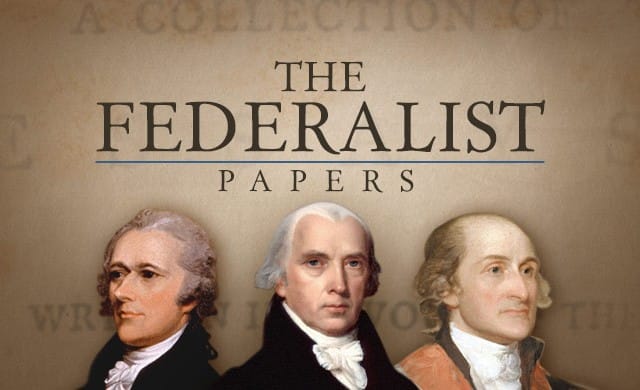
Thomas Jefferson pensaba que los niños debían aprender a leer con libros de Historia. El Federalista o “The Federalist Papers” cómo se les conoce en inglés son una colección de artículos publicados en New York previo a la ratificación de la nueva constitución de EUA en 1789, la mejor y más duradera constitución del mundo moderno. Escritos por James Madison, Alexander Hamilton y John Jay estos artículos explican con claridad el razonamiento detrás de la constitución. Dentro de los artículos los de Madison destacan por su claridad filosófica. Hamilton es hoy más popular y tiene una posición más inclinada a favorecer un gobierno federal fuerte. 

No todas las ideas prosperaron y no todas eran igual de buenas para establecer las bases de una República. Sin embargo, siguiendo el consejo de Jefferson, El Federalista es una lectura obligada hoy que muchos de los valores que la Constitución defienden se han puesto en duda y tergiversado. 

Un buen cierre de la lectura sería la advertencia de Benjamin Franklin cuando le preguntaron que habían hecho “una República si la pueden conservar”

>>>>>>>>>>>>>>>>><<<<<<<<<<<<<<<<<

Thomas Jefferson thought that kids should learn to read reading History books. The Federalist Papers is a collection of articles published in a New York newspaper before the ratification of the US Constitution in 1789, the best and longer lived constitution in the modern world. Written by James Madison, Alexander Hamilton and John Jay this columns explain with clarity the rationale behind the Constitution. Within the articles, Madison's outstand thanks to his philosophical clarity. Hamilton is currently the most popular of the three and has a position more incline in favor of a strong central government.

Not all the proposals thrived and not all were equally good to set the foundation of a Republic. However, following Jefferson's advice, The Federalist Papers are a must read today that many of the values that the Constitution defend are questioned and distorted.

A good closing for the book would be Benjamin Franklin's answer when he was inquired of what they did "A Republic if you can keep"

Monday, October 16, 2017

Vida y mentira de Ernesto Che Guevara

Ante el 50 aniversario de la muerte del Che y el nacimiento de un mito esta biografía revisada de Fernando Díaz Villanueva es muy oportuna. Con "Vida y mentira de Ernesto Che Guevara" Díaz Villanueva contribuye a desenmascarar la imagen fantasiosa del joven revolucionario inmortalizada en la fotografía de Alberto Díaz en camisetas, banderas, tatuajes y más medios de expresión modernos.

Desde el inicio el autor nos advierte el esfuerzo por elaborar un relato objetivo, algo difícil cuando se trata de un tipo que genera muchas emociones de un lado y del otro.


"El Che Guevara merecía ser biografiado, pero no para hablar bien de él, tampoco mal, simplemente para contar su vida de una manera apasionada y escéptica. Eso es, en definitiva, lo que pretende el presente libro."

Mi versión del Che
(hecho con imágenes de dominio púbico)

Creo que Díaz Villanueva con un relato bien hilvanado, con toques de ironía que si no fuera por la seriedad de las historias podría llegar a ser divertido, logra su cometido. Poco a poco la historia desempaca el perfil de un jóven oportunista y acomplejado que se creía más de lo que realmente era, el inconforme que saltando entre la adversidad y la suerte llegó a ser uno de los hombres más nefastos de la historia reciente de América Latina. 


El mito del Che ha multiplicado la malignidad del hombre al justificar las acciones de miles de hombres y mujeres. Ojalá la obra Fernando Díaz Villanueva llegue a las personas, sobre todo jóvenes, que viven en contradicción creyendo que defienden causas justas pero portan logotipos del Che. 

Saturday, July 15, 2017

Deep Thinking


In a world of pessimism a word of optimism is always welcome. This is what Garry Kasparov has to tell in his new book, "Deep Thinking, where machine intelligence ends and human creativity begins".

Garry Kasparov is a Russian born chess world champion and maybe the best grand master in history. After living in the soviet Azerbaijan he and his family escaped during the collapse of the Soviet Union. A democratic leader and opponent to the Putin regime he had to move to the US in 2013. He is the chairman of the Human Rights Foundation and has worked in defense of human rights and freedom for a long time.

This combination of chess master, computer geek and freedom lover permeates in his new book. He is a believer in the potential of humanity under a free systems despite its natural paradoxes.
"Even the most disciplined human mind wanders in the heat of competition. This is both a weakness and a strength of human cognition. Sometimes these undisciplined wanderings only weaken your analysis. Other times they lead to inspiration, to beautiful or paradoxical moves that were not on your initial list of candidates."
In Deep Thinking, Kasparov narrates his experience loosing against Deep Blue, IBM's supercomputer in a chess match in 1997. When a computer beat the world chess champion it became a tipping point for media and the public in the race of machine against humans.  Beyond a historic recollection of the events and some inside details that were not made public back then, Kasparov's book is a call for hope. Having experienced in person the overwhelming brute power of a computer he is not naïve in being optimist.
"Few people in the world know better than I do what it’s like to have your life’s work threatened by a machine. No one was sure what would happen if and when a chess machine beat the world champion."
The main thesis of Kasparov is that we can't know what is going to happen in the future but we should start from accepting that progress is unstoppable and desirable, therefore we shouldn't pretend to defend ourselves by holding it back.
"We don’t get to pick and choose when technological progress stops, or where. Companies are globalized and labor is becoming nearly as fluid as capital. People whose jobs are on the chopping block of automation are afraid that the current wave of tech will impoverish them, but they also depend on the next wave of technology to generate the economic growth that is the only way to create sustainable new jobs. Even if it were possible to mandate slowing down the development and implementation of intelligent machines (how?), it would only ease the pain for a few for a little while and make the situations worse for everyone in the long run."
Instead we should embrace change and formulate tougher and deeper questions. The combination of human creativity and machine brute power is super powerful, instead of fear of Artificial Intelligence - AI (machines replacing humans) we need Intelligence Amplification - IA (machines enhancing humans)
"We aren’t competing against our machines, no matter how many human jobs they can do. We are competing with ourselves to create new challenges and to extend our capabilities and to improve our lives. In turn, these challenges will require even more capable machines and people to build them and train them and maintain them—until we can make machines that do those things too, and the cycle continues. If we feel like we are being surpassed by our own technology it’s because we aren’t pushing ourselves hard enough, aren’t being ambitious enough in our goals and dreams. Instead of worrying about what machines can do, we should worry more about what they still cannot do." 
It is in the proper combination of humans and machines that we can reach our full potential.
"A clever process beat superior knowledge and superior technology. It didn’t render knowledge and technology obsolete, of course, but it illustrated the power of efficiency and coordination to dramatically improve results. I represented my conclusion like this: weak human + machine + better process was superior to a strong computer alone and, more remarkably, superior to a strong human + machine + inferior process."
But Kasparov positive vision has a caveat. It won't occur unless we have ambitious projects to pursuit and make important changes in politics, R&D, international cooperation and education.
"America still possesses the unique potential to innovate on a scale that can push the entire world economy forward. A world in which America is content with mediocrity is, literally, a much poorer world. 
R&D budgets have been slashed over the years as investors take a skeptical view of anything that doesn't feed the bottom line. Government-backed research tends to favor specific budgets to fit an existing need, not ambitious, open-ended mission to answer big questions. 
Trade wars and restrictive immigration regulations will limit America’s ability to attract the best and brightest minds, minds needed for this and every forthcoming Sputnik moment.
That our classrooms still mostly look like they did a hundred years ago isn’t quaint; it’s absurd. How can a teacher or even a stack of books be the sole source of information for kids who can access the sum of all human knowledge in seconds from a device in their pockets."
Kasparov's book is recommended to those worried about the future. I rate 4 stars because the book is a little repetitive and circular which makes the message less powerful and the reading a little weary.

As an additional reference, Tyler Cowen made an interesting interview to Garry Kasparov short ago(see transcript here) here is the audio.

Sunday, May 28, 2017

How to Be Everything

From "What do you want to be when you grow up?" to "What are you up to these days?"


Emilie Wapnick rose to fame after her TED talk "Why some of us don't have one true calling" that has almost 4M views. Emilie has devoted to help people who are "multipotentialites" or someone with many interests and creative pursuits. This book is an extension of her talk giving anecdotal support to what multipotentialites are, and what they do to be more effective in spite of their multiple interests and lack of consistency.


The book is a good intro for multipotentialites, a feel good, "Welcome to the tribe" (as the title of one the chapters) book. It provides some tools to assess if one is indeed a multipotentialite and its kind. Finally it offers some tools to improve effectiveness. However the books is somehow soft, in a way it is expected since the core idea of multipotentialites is that they don't follow social norms on how to live ones lives. Nonetheless, that lightness seems like a rationalization, an excuse to fail on delivering. Like it or not multipotentialites live in the real world where people expect results on time, on cost and on quality, no excuses.


Hope Wapnick work gets the attention in academic circles to become a research subject and thus future books and papers. Meanwhile you can find more about Wapnick and multipotentialites in her site Puttylike.com


Wednesday, March 29, 2017

Shoe Dog

Bill Gates recommended Phil Knight's book Shoe Dog in his 2015 annual blog. After reading Knight's story I can't but agree with Gates.

Shoe Dog is a very honest memoir of Knight and Nike (NYSE:NKE), full of business wisdom but also the challenges and setbacks. He didn't sugarcoated his story like many entrepreneurial books. Reading Shoe Dog is an emotional rollercoaster, from stories of adventure, success, failure, doubts, despair, sorrow, pride and joy.

Things I found amazing about Phil Knight:
  1. He prepared ahead for the adventure. From the very early pages he tells the story of how he wanted to travel around the world. With near $0 budget yet "I spent weeks, reading, planning, preparing for my trip." similar stories are prefaces to his first trip to Japan, to Taiwan and China. 
  2. He cared for his team, having hired very odd people at the beginning mainly trying to help them to his support for the athletes they sponsored.
  3. He recognized his business journey very honestly, from making money, to dominate the market to contribute to the human drama. "I redefined winning, expanded it beyond my original definition of not losing, of merely staying alive. That was no longer enough to sustain me, or my company. We wanted, as all great businesses do, to create, to contribute, and we dared to say so aloud."
  4. His almost devotion to his coach and cofounder, Bill Bowerman, as well as to other people who contribute to Nike success. Constantly not letting Bowerman behind, naming the buildings after supporters, his appreciation for Tiger Woods, etc. 
  5. His connection with his family could be omitted but it helps to appreciate Knight's humanity. The struggle between a growing business and his family, his regret for not having spend enough time with his kids, his apologies to his wife, Penny, for having to waited and waited, 

The book has some pearls of business wisdom too, not as a recipe but as a testimony.
  1. Cash management is crucial specially for a fast growing business.
  2. Plans have a short life, specially when conditions change.
  3. Tell people what you want and let them surprise you with their results
  4. When you believe in something being stubborn pays off, but if you have doubts trust your team.
  5. An IPO may be necessary but the timing is important.
For those interested in entrepreneurship this book is a must. 

An interesting conversation with HBR Ideacast.