Showing posts with label Learn. Show all posts

Saturday, July 20, 2019

Unschooled

Reading Kerry McDonald's Unschooled reminded me my early years as a parent. Despite not being satisfied with the educational system, we accepted with resignation that we had no option for our kids. We tried to choose the "best" school, however mostly the differences were the quality of the people leading the schools and their teachers. Even a friend tried to convince us to home-school our kids but we felt it was the same (school at home) minus the "socialization". Years later we were invited by another friend to join an alternative school, an off-the-system project. It was a challenge because people around us opposed and voiced their opinions with comments like "you are going to ruin your kids lives", and so. The project was worth, not because of pure opposition to the mainstream, but being off-the-system allowed them to offer a truly student center project with mixed ages, learners community, no-grades, no-homework, etc.

All this process was scary because we had no reference beyond the myth of schooling, the same myth we grew up with and we have survived!!! Was this our tantrum against the system and our kids were going to pay the price? The problems with the traditional schooling and the benefits of these new projects are well supported by theory and scholars yet little evidence was available to confirm that it works in practice. And this is where Unschooled fills the void. Using Kerry's own words 
"Schooling has become so engrained in our culture and conversation that disentangling it from learning takes time and though. Not only do we need to unschool our own thinking but also we need to help others do the same."
Unschooled is McDonald's "personal views and experiences related to unscholling and self-directed education" nonetheless it is very well documented. From John Locke to Peter Gray the breadth of references is a proof of the seriousness of her work. Along the theoretical references Unschooled offers a mosaic of real people's experiences doing what they believe is best for the kids. Unschooling is a movement that has its roots in the progressive reforms of the 1960's, it has reborn with a core difference "one refreshing change with today's unschooling movement is that it is being driven not by philosophers but by parents"

The book covers the history of unschooling, gives a definition and contrast it with schooling, and tackles some myths like; the curriculum, freedom is not license, appropriate ages to learn math or reading, and more. Also the book has a good diagnosis of the problems of the mainstream system and how it has worsen over the years despite efforts to fix it. Kerry McDonald is straight and honest in this respect "what we need conventional public schools to become if they are to truly move from a schooling paradigm to a learning one. They need to be built entirely from scratch."

In a later part of Unschooled, is a section with resources for unschoolers. From technology, resource centers, fab labs, maker spaces, libraries, revolutionary schools, apprenticeships, adventure playgrounds, and more. In summary this section is a window of options and an invitation to join and start a resource for our own communities. 

The last chapter is an outlook of the future of unschooling, which can be summarized in Kerry's call to action: 
"It all comes down to parents. It will be parents who decide whether or not we move toward an unschooled future. It will be parents who determine whether or not to reclaim their child's education."
The only subject I think the Unschooled is missing is the labor markets. As long as companies keep hiring by degree (the sheepskin effect that Brian Caplan describes in his book The Case Against Education) the unschooled future is riskier, specially for lower income families who can't rely on friends, connections, or family safety nets. There is some hope in this regard after some tech giants are dropping the diploma from their hiring process, but it is far from generalized practice. 

If you want to learn more about Kerry McDonald check her blog Whole family learning


Thursday, June 14, 2018

Montessori: The Science Behind the Genius

Maria Montessori was an empiricist in many ways and her method developed from careful observation of children. In this book Angeline Stoll provides extensive research background to fill the voids of scientific support of the famous educational method.

In her book, Stoll addresses each of the eight principles of Montessori Education, providing support with specific research and expanded with actual Montessori practices. 

In most of the cases Montessori proved being in line with science, upholding the value of the method.


  1. Movement and cognition
  2. Choice and control
  3. Interest
  4. Motivation
  5. Collaborative learning
  6. Meaningful context
  7. Adult-child interaction
  8. Order and the environment

Stoll criticizes the traditional school system in different parts of the book, with a two-fold argument: The system is based on the Lockean view of the blank-slate mind; an empty container that needs to be filled with information (this is an oversimplification of Locke's view but the mainstream system seems to fit Stoll's interpretation). Thus, the system is organized for most efficient transmission as a manufacturing line. Maria Montessori recognized that children are born with dispositions to learn and each child is different, therefore the education method should facilitate that. From Stoll’s work we can conclude that Montessori is a superior education system than the standard offer for families and society.

However, there are a few issues to consider for further research.

Winning against the standard educational system is not a big challenge. Most of recent theories of how the mind works show that the empty vessel filled in a manufacturing line is plain wrong. The true contestants are innovative models that value the same principles as Montessori; such as Forest Schools, Free education (i.e. Sudbury School), unschooling, etc. However, this kind of research is hard to find since these practices are not widespread. Probably there is no right or wrong answer as different models satisfy different needs and tastes.

The value of research has some inherent flaws. Stoll is careful at explaining the limitations and through combining independent studies she ties in the conclusions. However most of these studies were made in school setting and as a play advocate once said; “studying children in schools is like studying wildlife in zoos”. Also, as Stoll quotes, “studying children in an environment that is not well prepared would be like trying to study normal cell growth in an infected petri dish”. There is a broad spectrum of Montessori implementations, how to know how the specifics degrees of preparedness of the cases affected the results?

From the play profession point of view, it is interesting the overlap between Montessori and play. However, Stoll explains that Maria Montessori had a limited understanding of play, reduced to toys that may sound opposite. 
“Dr. Montessori divided our hours into those for leisure and those spent at school. She implies that children may well choose to play with toys in their leisure time, just as we may choose to play chess, but that in the schools she structured, children did not choose to play.”
A more comprehensive understanding of play highlights the similarities. Using Peter Gray’s definition (Free to Learn). 
  1. Play is self-chosen and self-directed. This is coherent with the second principle of Montessori, choice and control. Play is an expression of freedom and Montessori give agency of learning to the child.
  2. Play is motivated by means more than ends. Play is activity conducted primarily for its own sake. Gray says “a playful student enjoys studying the subject and cares little about the test”, something very much related to the importance of personal interests and intrinsic motivation in Montessori. Same as grades, stars and rankings kill intrinsic motivation in education, turn free play into a competition.
  3. Play is guided by mental rules. Some of the critique to Montessori are its rules that Stoll explain is a balance that give freedom in some areas and structure in others. People need rules to operate either in play, school, society and work. In play children are agents in the definition of rules maybe more than in a Montessori school, but both offer way more freedom than traditional schools. This could be one of the areas of further research.
  4. Play is imaginative. Although Montessori discourage the use of fantasy in little children based on their inability to distinguish between fantasy and reality, creativity, play-pretend and sociodramatic elements of Montessori are based on the imagination of children. 
  5. Play is conducted in an alert but non-stressed frame of mind. The concept of flow is part of interest, context and even the purpose of what is the proper environment. 

The role of playworkers is quite similar of the role of the Montessori teacher, their goal is to disappear and just provide the right amount of clues to provoke children. Playworkers care for the quality of the playground as the teacher prepare the environment. Playworkers carefully observe the child at play just like the teacher observe the absorbent mind at work. And of course, the aphorism of Play is the Child’s Work is common to both. Of course, not everything is the same. For play advocates the affordances of items are important, the multiple uses that a person can give to a give object is discourage in Montessori classroom where each material is purposefully designed for a specific use.

It seems like children don’t find Montessori materials as alternative to toys but as engaging. Bob Hughes’ taxonomy of play (“Evolutionary Playwork”) can shed some light here.  A lot of the Montessori activities and materials can fit in some of the play types. 

Communication play is in the movable alphabet, sandpaper letters and other grammar exercises. Creative play is in the approach to science. Dramatic play and the understanding of how society works. Exploratory play and the multiple materials from the pink tower to the sound cylinders.  Mastery play is the end of Montessori three period lesson. Object play is the constant manipulation of objects such as the brown stairs, the red rods or the wooden cylinders to name a few. Recapitulative play is involved in the timeline of life or civilization. Role Play seems to be part of the appealing of Practical Life. Social play manifests in peer-to-peer and collaborative work and the mixed age groups. 

No wonder why kids can spend three hours of hard work; the program is structured as a flow of games where children enjoy enough freedom to manage their energy and attention. It is not hard to understand Maria Montessori’s reluctance about recess. In traditional schools, kids may be focused on an activity they enjoy as play and are forced to go out doing less interesting stuff. The pro-recess advocates critique the lack of freedom during breaks in traditional schools, it is not the same as in a well-run Montessori school. 

Finally advances in neuroscience could open a new door of research to connect the benefits of a Montessori method as well as all other alternatives that are popping and challenging the mainstream institutionalized education system. This could very well be the subject of another book but could provide the ultimate validation to the Genius.

Sunday, June 22, 2014

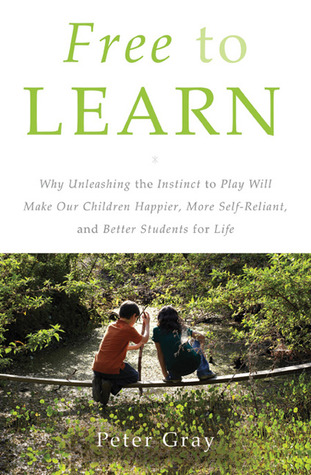
Free to Learn

In Free to Learn, Peter Gray brings another piece to the puzzle of Education. From his anthropological point of view he presents the case of how Play is the natural learning process while school is an institution design to control and alienate children. 

Overall Gray challenges parents to acknowledge that the system is destroying their children and that once the accept that they don´t want this for their children they can't continue supporting the current rotten system. Gray invites parents to try different alternatives, to trust their kids and create an environment that support their creativity and interaction.

I disagree on some contextual elements like his description of the Industrial Revolution. Nonetheless his message raises more questions and avenues to explore and research.

My rating 5 out of 5.