Showing posts with label Play. Show all posts

Saturday, July 20, 2019

Unschooled

Reading Kerry McDonald's Unschooled reminded me my early years as a parent. Despite not being satisfied with the educational system, we accepted with resignation that we had no option for our kids. We tried to choose the "best" school, however mostly the differences were the quality of the people leading the schools and their teachers. Even a friend tried to convince us to home-school our kids but we felt it was the same (school at home) minus the "socialization". Years later we were invited by another friend to join an alternative school, an off-the-system project. It was a challenge because people around us opposed and voiced their opinions with comments like "you are going to ruin your kids lives", and so. The project was worth, not because of pure opposition to the mainstream, but being off-the-system allowed them to offer a truly student center project with mixed ages, learners community, no-grades, no-homework, etc.

All this process was scary because we had no reference beyond the myth of schooling, the same myth we grew up with and we have survived!!! Was this our tantrum against the system and our kids were going to pay the price? The problems with the traditional schooling and the benefits of these new projects are well supported by theory and scholars yet little evidence was available to confirm that it works in practice. And this is where Unschooled fills the void. Using Kerry's own words 
"Schooling has become so engrained in our culture and conversation that disentangling it from learning takes time and though. Not only do we need to unschool our own thinking but also we need to help others do the same."
Unschooled is McDonald's "personal views and experiences related to unscholling and self-directed education" nonetheless it is very well documented. From John Locke to Peter Gray the breadth of references is a proof of the seriousness of her work. Along the theoretical references Unschooled offers a mosaic of real people's experiences doing what they believe is best for the kids. Unschooling is a movement that has its roots in the progressive reforms of the 1960's, it has reborn with a core difference "one refreshing change with today's unschooling movement is that it is being driven not by philosophers but by parents"

The book covers the history of unschooling, gives a definition and contrast it with schooling, and tackles some myths like; the curriculum, freedom is not license, appropriate ages to learn math or reading, and more. Also the book has a good diagnosis of the problems of the mainstream system and how it has worsen over the years despite efforts to fix it. Kerry McDonald is straight and honest in this respect "what we need conventional public schools to become if they are to truly move from a schooling paradigm to a learning one. They need to be built entirely from scratch."

In a later part of Unschooled, is a section with resources for unschoolers. From technology, resource centers, fab labs, maker spaces, libraries, revolutionary schools, apprenticeships, adventure playgrounds, and more. In summary this section is a window of options and an invitation to join and start a resource for our own communities. 

The last chapter is an outlook of the future of unschooling, which can be summarized in Kerry's call to action: 
"It all comes down to parents. It will be parents who decide whether or not we move toward an unschooled future. It will be parents who determine whether or not to reclaim their child's education."
The only subject I think the Unschooled is missing is the labor markets. As long as companies keep hiring by degree (the sheepskin effect that Brian Caplan describes in his book The Case Against Education) the unschooled future is riskier, specially for lower income families who can't rely on friends, connections, or family safety nets. There is some hope in this regard after some tech giants are dropping the diploma from their hiring process, but it is far from generalized practice. 

If you want to learn more about Kerry McDonald check her blog Whole family learning


Friday, June 21, 2019

Play to Live

Play to Live is a book for those who still haven't buy the importance of play for children and adults alike. If you know someone who still believes that play is a childish waste of time, give Brian VanDongen's book. 
"Play is not just important to education; play is education.  Play is not just important to a healthy lifestyle; play is a healthy lifestyle. Play is not just important to life skills; play is a life skill."
Without going into the depth of research on play this is a convincing invitation. Invitations to allow more play time to children and also to permit ourselves, as adults, to play.
"You have my permission: Be playful."

Children and Play in the Holocaust

Children and Play in the Holocaust is a emotionally hard to read essay by George Eisen. With a long list of references Eisen presents the experience of children in ghettos, detention centers and concentration camps during the Nazi occupation. These stories challenge the classical theory of play but also reinforce how play is so encoded in our genes that is almost unavoidable. 
"Play burst forth spontaneously and uncontrollably without regard of the external situation."
The sociological, psychological, physiological and even political aspects of life during the Holocaust are visited under the lens of children, and adult, play.
"Their play, just like all human experiences, was reflective of and governed by societal, psychological, and economic conditions of the society in which they took place."

For the people in the play field the book can be used as a catalog of play experiences to be classified under the 16 play types by Bob Hughes; to identify the play cycle and the role of adults in free play.

Thursday, June 14, 2018

Montessori: The Science Behind the Genius

Maria Montessori was an empiricist in many ways and her method developed from careful observation of children. In this book Angeline Stoll provides extensive research background to fill the voids of scientific support of the famous educational method.

In her book, Stoll addresses each of the eight principles of Montessori Education, providing support with specific research and expanded with actual Montessori practices. 

In most of the cases Montessori proved being in line with science, upholding the value of the method.


  1. Movement and cognition
  2. Choice and control
  3. Interest
  4. Motivation
  5. Collaborative learning
  6. Meaningful context
  7. Adult-child interaction
  8. Order and the environment

Stoll criticizes the traditional school system in different parts of the book, with a two-fold argument: The system is based on the Lockean view of the blank-slate mind; an empty container that needs to be filled with information (this is an oversimplification of Locke's view but the mainstream system seems to fit Stoll's interpretation). Thus, the system is organized for most efficient transmission as a manufacturing line. Maria Montessori recognized that children are born with dispositions to learn and each child is different, therefore the education method should facilitate that. From Stoll’s work we can conclude that Montessori is a superior education system than the standard offer for families and society.

However, there are a few issues to consider for further research.

Winning against the standard educational system is not a big challenge. Most of recent theories of how the mind works show that the empty vessel filled in a manufacturing line is plain wrong. The true contestants are innovative models that value the same principles as Montessori; such as Forest Schools, Free education (i.e. Sudbury School), unschooling, etc. However, this kind of research is hard to find since these practices are not widespread. Probably there is no right or wrong answer as different models satisfy different needs and tastes.

The value of research has some inherent flaws. Stoll is careful at explaining the limitations and through combining independent studies she ties in the conclusions. However most of these studies were made in school setting and as a play advocate once said; “studying children in schools is like studying wildlife in zoos”. Also, as Stoll quotes, “studying children in an environment that is not well prepared would be like trying to study normal cell growth in an infected petri dish”. There is a broad spectrum of Montessori implementations, how to know how the specifics degrees of preparedness of the cases affected the results?

From the play profession point of view, it is interesting the overlap between Montessori and play. However, Stoll explains that Maria Montessori had a limited understanding of play, reduced to toys that may sound opposite. 
“Dr. Montessori divided our hours into those for leisure and those spent at school. She implies that children may well choose to play with toys in their leisure time, just as we may choose to play chess, but that in the schools she structured, children did not choose to play.”
A more comprehensive understanding of play highlights the similarities. Using Peter Gray’s definition (Free to Learn). 
  1. Play is self-chosen and self-directed. This is coherent with the second principle of Montessori, choice and control. Play is an expression of freedom and Montessori give agency of learning to the child.
  2. Play is motivated by means more than ends. Play is activity conducted primarily for its own sake. Gray says “a playful student enjoys studying the subject and cares little about the test”, something very much related to the importance of personal interests and intrinsic motivation in Montessori. Same as grades, stars and rankings kill intrinsic motivation in education, turn free play into a competition.
  3. Play is guided by mental rules. Some of the critique to Montessori are its rules that Stoll explain is a balance that give freedom in some areas and structure in others. People need rules to operate either in play, school, society and work. In play children are agents in the definition of rules maybe more than in a Montessori school, but both offer way more freedom than traditional schools. This could be one of the areas of further research.
  4. Play is imaginative. Although Montessori discourage the use of fantasy in little children based on their inability to distinguish between fantasy and reality, creativity, play-pretend and sociodramatic elements of Montessori are based on the imagination of children. 
  5. Play is conducted in an alert but non-stressed frame of mind. The concept of flow is part of interest, context and even the purpose of what is the proper environment. 

The role of playworkers is quite similar of the role of the Montessori teacher, their goal is to disappear and just provide the right amount of clues to provoke children. Playworkers care for the quality of the playground as the teacher prepare the environment. Playworkers carefully observe the child at play just like the teacher observe the absorbent mind at work. And of course, the aphorism of Play is the Child’s Work is common to both. Of course, not everything is the same. For play advocates the affordances of items are important, the multiple uses that a person can give to a give object is discourage in Montessori classroom where each material is purposefully designed for a specific use.

It seems like children don’t find Montessori materials as alternative to toys but as engaging. Bob Hughes’ taxonomy of play (“Evolutionary Playwork”) can shed some light here.  A lot of the Montessori activities and materials can fit in some of the play types. 

Communication play is in the movable alphabet, sandpaper letters and other grammar exercises. Creative play is in the approach to science. Dramatic play and the understanding of how society works. Exploratory play and the multiple materials from the pink tower to the sound cylinders.  Mastery play is the end of Montessori three period lesson. Object play is the constant manipulation of objects such as the brown stairs, the red rods or the wooden cylinders to name a few. Recapitulative play is involved in the timeline of life or civilization. Role Play seems to be part of the appealing of Practical Life. Social play manifests in peer-to-peer and collaborative work and the mixed age groups. 

No wonder why kids can spend three hours of hard work; the program is structured as a flow of games where children enjoy enough freedom to manage their energy and attention. It is not hard to understand Maria Montessori’s reluctance about recess. In traditional schools, kids may be focused on an activity they enjoy as play and are forced to go out doing less interesting stuff. The pro-recess advocates critique the lack of freedom during breaks in traditional schools, it is not the same as in a well-run Montessori school. 

Finally advances in neuroscience could open a new door of research to connect the benefits of a Montessori method as well as all other alternatives that are popping and challenging the mainstream institutionalized education system. This could very well be the subject of another book but could provide the ultimate validation to the Genius.

Friday, May 4, 2018

Reality Is Broken: Why Games Make Us Better and How They Can Change the World

Reality Is Broken: Why Games Make Us Better and How They Can Change the World Reality Is Broken: Why Games Make Us Better and How They Can Change the World by Jane McGonigal
My rating: 5 of 5 stars

Currently we see everywhere from the news to the dinner table people complaining about video games and screens. What most people don't realize is that video games have been part of life for over 40 years. Many of the ones complaining used to spend hours at arcades or playing with early video consoles. Video games are part of reality and no matter how much we disagree they will not go away anytime soon. According to a Newzoo report "2.2 billion gamers across the globe are expected to generate $108.9 billion in game revenues in 2017".

Jane McGonigal is a game developer who shares her 10+ yrs experience developing video games. She explains how for gamers Reality is Broken because when they contrast their real life (school, work, etc.) and their virtual worlds they find in the later a lot of the values reality no longer provide.
"Gamers want to know: Where, in the real world, is that gamer sense of being fully alive, focused, and engaged in every moment? Where is the gamer feeling of power, heroic purpose, and community? Where are the bursts of exhilarating and creative game accomplishment? Where is the heart-expanding thrill of success and team victory? While gamers may experience these pleasures occasionally in their real lives, they experience them almost constantly when they’re playing their favorite games."
Games have some characteristics that are more or less common. A sense of purpose, a goal. They have rules that define boundaries and within unleash creativity and foster strategic thinking. Games have a feedback system that keep games engaged and motivated. Finally, McGonigal includes voluntary participation that is important for community formation. A fifth characteristic not included in the book is competition. Which is interesting because as later explained in the book, gamers are good at cooperation. Even in games that are about winning gamers find more motivation in collaborative modes.

McGonigal explains how game developers not only are good at games but have a better understanding of positive psychology and human motivation than most reality developers. Schools, companies, communities and even play spaces and parks miss those elements. No wonder when people have a choice digital easily wins.
“Game designers and developers are actively transforming what once was an intuitive art of optimizing human experience into an applied science. And as a result, they are becoming the most talented and powerful happiness engineers on the planet.”
But the most amazing insight is the power of Massive Multiplayer Online (MMO) Role-playing game (RPG). For instance, World of Warcraft gamers had spent over 5.93 million years solving challenges over the first six years. McGonigal proposal is to tap the power of MMO to tackle world problems. Not only local problems but those that require massive efforts such as pandemics, food supply, energy, network security, and migration. Through Alternate Reality Games - ARGs (ARGs are games you play to get more out of your real life, as opposed to games you play to escape it.)" players can bring all the good of video games to the real world.

Throughout the book, Jane McGonigal suggests 14 fixes to reality, in other words; how can we bring the excitement and motivation to our regular lives and more? With ideas such as:
"(Fix #2: Activate extreme positive emotions). That’s why games can put us in a positive mood when everything else fails—when we’re angry, when we’re bored, when we’re anxious, when we’re lonely, when we’re hopeless, or when we’re aimless.” 
“We’ve discovered how game designers help us achieve a state of blissful productivity: with clear, actionable goals and vivid results (Fix #3: Do more satisfying work). We’ve seen how games make failure fun and train us to focus our time and energy on truly attainable goals (Fix #4: Find better hope of success). We’ve seen how they build up our social stamina and provoke us to act in ways that make us more likeable (Fix #5: Strengthen your social connectivity), and how they make our hardest efforts feel truly meaningful, by putting them in a much bigger context (Fix #6: Immerse yourself in epic scale)." 
"We’ve considered how points, levels, and achievements can motivate us to get through the toughest situations and inspire us to work harder to excel at things we already love (Fix #8: Seek meaningful rewards for making a better effort). We’ve looked at how games can be a springboard for community and build our capacity for social participation (Fix #9: Have more fun with strangers). " 
“crowdsourcing games that successfully engage tens of thousands of players in tackling real-world problems for free (Fix #11: Contribute to a sustainable engagement economy).”
Instead of fighting against video games people should learn and incorporate their best practices to life. In addition, this could empower people to collaboratively solve big world problems.


View all my reviews

Tuesday, March 27, 2018

The Self-Driven Child

The Self-Driven Child is an excellent book for parents worried about their children's future. 
"Parental anxiety isn't new. Parents have worried about their kids ever since having kids was a thing, but we believe it's worse now than before. Why? For one, we have a lot more information than we've ever had before."
I recommend "The Self-Driven Child" next to Madeline Levine "Teach your Children Well", and Alison Gopnik "The Gardener and the Carpenter". Books with supported research that help parents, and kids, enjoy themselves lowering anxiety and stress.
"Remember that your job is not to solve your children's problems but to help them learn to run their own lives"
"Your responsibility is to love and support your child. It isn't your responsibility to protect him from pain. You can't."
Stixrud and Johnson combine modern theory of neuroscience, positive psychology, and education, research references plus their own clinical practice experience along cases and practical advice. The first part of the book covers the theoretical foundation before getting into more actual problems like sleep, electronics and college.

In the end our goal as parents should be to love and enjoy our kids, to trust they will know how to get up on their feet and move along. And in the end, they will always come back when they need us.
"In a competitive, overly busy world, it's so easy to forget the basics: that enjoying your kids is one of the best things you can do for them, and for yourself."
"Teachers can teach, coaches can coach, guidance counselors can outline graduation requirements, but there's one thing only parents can do: love their kids unconditionally and provide them with a safe base at home."
The last section about college needs to be taken with a pinch of salt. If we assume p is the probability of succeeding after college and (1-p) the probability of not succeeding, and q the probability of succeeding without college and (1-q) is the the opposite. Stixrud and Johnson don't account if p>(1-p) and q<(1-q). Even the cases they develop show that succeeding without college is hard, maybe harder than succeeding in college. Yet succeeding in college by no means equals a happy life. If parents lower their expectations about their kids going to college they should acknowledge that a support system for their kids increases their chances. Considering that some college is the same as no college, the book check-list to evaluate if kids are ready for college is quite valuable. I recommend also reading Bryan Caplan "The Case Against Education", it complements what Stixrud and Johnson say. 

My rating 4 stars.

Friday, February 17, 2017

Playborhood

Mike Lanza is a Silicon Valley entrepreneur with whom I identified, not because his professional career but his devotion to his children and family. Like me, and many parents, Mike was concerned by the few opportunities children have to freely play this days. 

Mike's story came to me after reading an article in the New York Times by Melanie Thernstrom. The story was interesting but had a feeling of critique that I couldn't understand. Mike is not a play expert but a father who is not sitting in his couch whining and waiting for the government to fix his problem, he honestly is trying to provide a safe and fun environment for his kids to play. It was a relief to read play experts like Tim Gill, Peter Gray or  Lenore Skenazy, appreciate what Lanza is doing. 

But Mike didn't stop at doing something for his kids, he wrote Playbordhood. He researched about other initiatives all over the US of people acting and not just complaining. People of different socioeconomic backgrounds, in different setting, with different approaches. His book is not only a collection of stories but a guide for those who want to do something; from selecting the right neighborhood, to creating attractions for kids, to building a community, and more. He lays out a plan on how to create a playborhood. He is not naive in pretending that this is a magic potion that will fix the problem, kids outgrow the attractions, there is fierce competition from electronics, other parents have their own fears and preferences, etc. His message can be summarized as don't give up and keep trying. 
"My approach has been to stay the course as long as the positive response outnumber positive responses outnumber the negative ones. When I do get a specific negative reaction, I try to accommodate whatever complaint the neighbor might have."
Some of the critiques to Mike's solution are that he is an affluent Silicon Valley entrepreneur and thus he can spend lots of money on his playground. Mike challenges this idea not only by recognizing other initiatives with fewer resources but invites people to put their money in their priorities.
"I hope readers of this book will re-evaluate the relative budgets for the inside and outside of their homes. When weather is OK, a great yard is far more important to kids than the inside of the house. Moreover, even in bad weather months, kids don't appreciate expensive decor at all..... Having a great home entertainment system inside the house is attractive for them, but they will benefit far more from a great yard"
One of the key concepts of Playborhood is they are right were children live. Other alternatives like playgrounds and city parks are places where kids can't go on their own at the time they please. Going to those places become a planned activity. People come from different locations making it hard to create a culture of play and a community. Playborhoods have their issues, Mike may have done things differently from suggested by experts but the big picture is that this is an idea to stimulate others to act and improve.


Monica and me visiting Mike's playborhood

Sunday, June 22, 2014

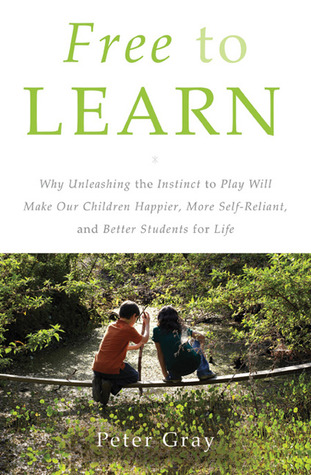
Free to Learn

In Free to Learn, Peter Gray brings another piece to the puzzle of Education. From his anthropological point of view he presents the case of how Play is the natural learning process while school is an institution design to control and alienate children. 

Overall Gray challenges parents to acknowledge that the system is destroying their children and that once the accept that they don´t want this for their children they can't continue supporting the current rotten system. Gray invites parents to try different alternatives, to trust their kids and create an environment that support their creativity and interaction.

I disagree on some contextual elements like his description of the Industrial Revolution. Nonetheless his message raises more questions and avenues to explore and research.

My rating 5 out of 5.