Showing posts with label Liberalism. Show all posts

Wednesday, December 18, 2019

Progress

Johan Norberg offers a recount of how the world is much better today than anytime in history. Progress covers different facets of human life. 

  • Food 
  • Sanitation
  • Life expectancy
  • Poverty
  • Violence
  • Environment
  • Literacy
  • Equality
  • Childhood (Next generation)
In all of these Norberg lays out evidence on how, thanks to values of the Enlightenment and their implementation in capitalism and liberalism, life has dramatically improved. Only this system allowed amazing progress  while sustained a huge population growth.
"Between 1950 and 2011 world population grew from 2.5 to seven billion. This did not happen because people in poor countries started breeding like rabbits, as people sometimes assumed; it happened because they stopped dying like flies. But it did not take long until families started adapting. As parents came to realize that their children were less likely to die young, they stopped having as many babies."
There are still battles to win but instead of turning our backs to the causes of progress we should defend and embrace them.

Progress is a book about optimism, its Johan Norberg's invitation to move forward instead of sit to complaint and cry.

Monday, December 16, 2019

Permanent Record

Permanent Record by Edward Snowden

"The closest thing to science fiction I've ever seen in science fact" - Edward Snowden

Wednesday, November 13, 2019

Humanomics

Vernon Smith, Nobel prize winner 2002, and Bart Wilson are renowned experimental economists. They faced an apparent contradiction when neoclassical utility maximization or Max-U model, that explained perfectly well supply-and-demand market experiments, failed in two-person games. Behavioral and experimental economists explained the differences ex-post as "social preferences".

Humanomics is a neologism in reference to the study of the human problem as both personal social and impersonal economic.

Morality is an emergent order based on the will of the people to seek praise and praiseworthiness and avoid blame and blameworthiness. "In Adam Smith's model of human social conduct, actions are governed by context-dependent rules based on experience and human capacity for mutual sympathetic fellow-feeling". In other words, humans have the capacity to extract the accepted rules by observing and feeling others around.

None of the authors, including Adam Smith, are experts on play but it is striking how they recognize and fit the role of play in children to understand the moral rule set.
"The child naturally wishes to gain their favour, and to avoid their hatred or contempt... and it soon finds that it can do so in no other way than by moderating, not only its anger, but all its other passions, to the degree which its play-fellows and companions are likely to be pleased with."
The capacity to understand the moral rules is context free but the rules in themselves are context relevant. Societies flourish when that mutual support is provided in the reciprocity of gratitud and friendship bound together in good offices of affection and esteem". Societies thrive when their rules promote cooperation, exchange and mutual respect.

One key takeaway from Humanomics is that human behavior follows some general rules on how rules are set, yet the specific rules are different based on time and context. Therefore, we can't use the same rule set to evaluate two different results. But we can identify some common denominators in functional system vs dysfunctional ones.
"When dealing with human beings, we must get comfortable with the imprecision of our humanity"
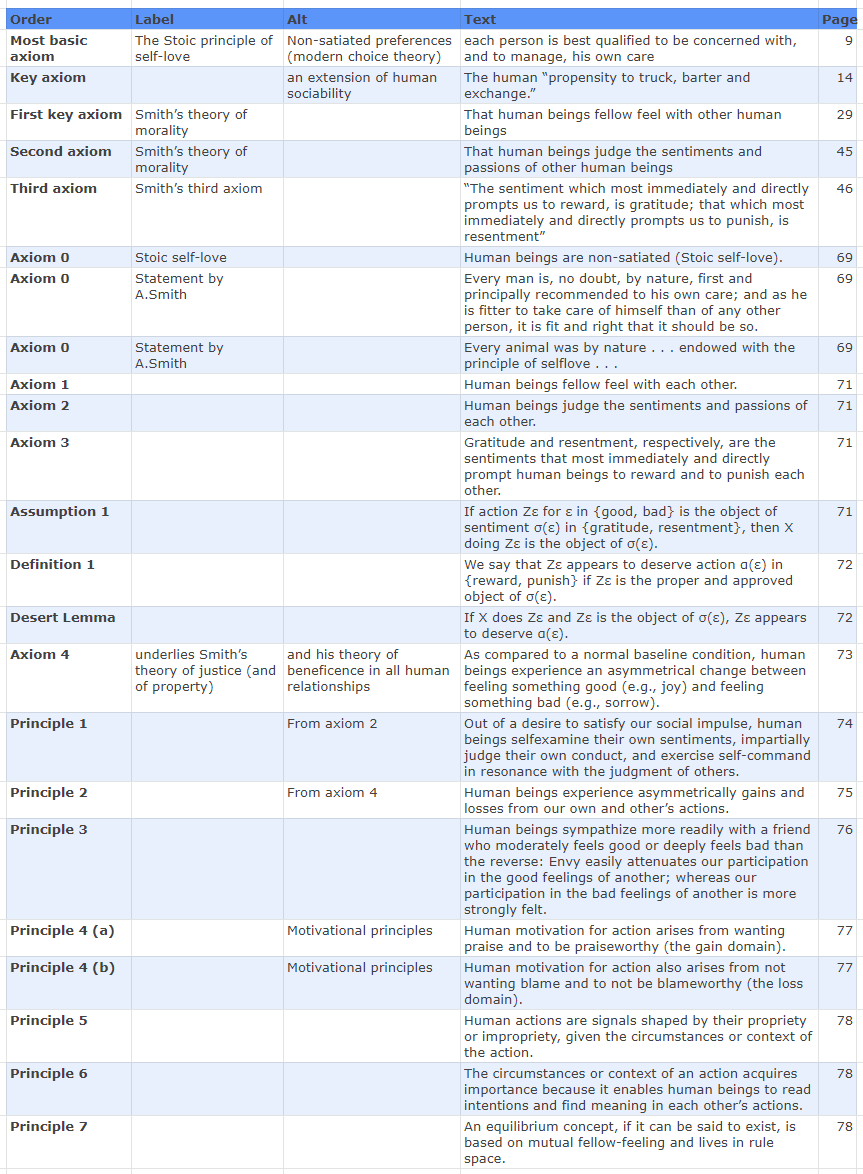
Smith and Wilson coded Adam Smith's ideas in a series of Axioms and Principles, summarized by Leonel Morales, "One aim in restating Smith's propositions as we do is to spell out the simplicity and universality with which he can be read".


Smith and Wilson proceed to analyze some classical games and see how these axioms and principles can explain the results, opposite to the failure of Max-U and behavioral economics. Finally they use Adam Smith's theory to predict the outcome of a new set of games. 

For the authors Adam Smith Theory of Moral Sentiments is a better model to explain how people interact. The analysis also closes the apparent gap between the Theory of Moral Sentiments and the Wealth of Nations. 
"His project in Sentiments is to address how moral conduct emerges out of human interactive experience to form a system of general rules that wisely order society. In Wealth he extends that system to markets and national economy to enable a better understanding of the sources and evolution of the economic order."

Monday, December 7, 2015

The Frankenstein Candidate

Vinay Kolhatkar novel is set in a near future by the US elections of 2020. A multimillionaire, Frank Kenneth Stein, who decides to fund his own presidential campaign breaking with the traditional parties. Quite the opposite of a Donald Trump who has the money but not the brains, Stein has clear and consistent ideas, thus many time conflicting.

With a complex plot full of obscure characters the novel unfolds the worst crises in history due to the games politicians play. A game that they can't stop without burning themselves and therefor are willing to do whatever to keep the wheel spinning.

The democratic presidential candidate, Olivia Allen is facing as rival the Republican Vice-President Quentin Kirby but soon realizes who the real enemy is.

Olivia Allen is a iconic character; beautiful, successful professionally and socially. It is easy to identify with her honest will to improve the system. Her optimism about working hard and fix what needs to be fixed is appealing. It is easy to feel empathy for her struggle between facing these life challenges and saving her personal life. As many of us, she realizes that the task is paramount because it goes against the stakeholders of the system. Olivia's philosophical transformation is encouraging, a hope that if people decide to think and not just hope the system may change.

The Frankenstein Candidate is a work of fiction but also a believable future. If the political system doesn't overhauls itself, which is very improbable, the size of the next crisis can be unthinkable. With the size of national and local debts, the level of monetary emission, the choking regulatory framework, and the irrational obsession with climate change, the future of a world is not shinny. Can the system be changed from within or the chances are nil leaving the only hope on a third contender with clear ideas and the pockets to compete. 

Frank Stein campaigns around the ten commandment of government; "honesty, forbearance, temperance, respect, integrity, kinship, courage, justice, dignity and humanity". This could be a model to measure how good or bad is a proposal since most of the politician promises fail on several of them. Overall these commandments are just traits of humanity.

Nice novel for the times. Now that we have elections in different parts of the world and many are about choosing the least bad.

My rating 4 stars

Sunday, December 6, 2015

Omnipotent Government

Ludwin Von Mises wrote Omnipotent Government in 1944 at the last days of WWII. Mises describes the philosophical grounds of the Nazi movement. A book rich in history background and a though provoking plan for the future.

In the first part Mises explains the German Liberalism during the middle of the XIX when the ideas of the classical Liberalism were partially adopted in Germany. According to Mises:
"At about the middle of the nineteenth century those Germans interested in political issues were united in their adherence to liberalism. Yet the German nation did not succeed in shaking off the yoke of absolutism and in establishing democracy and parliamentary government."
Mises explains the history of Germany from the late XVIII to the early XX with a different point of view from the dominant Socialist Historians. Overall he shows how and why a powerful-educated German society fell into Nazism.
"The questions to be answered are not: Why did the bankers and the rich entrepreneurs and capitalists desert liberalism? Why did the professors, the doctors, and the lawyers not erect barricades? We must rather ask: Why did the German nation return to the Reichstag members who did not abolish absolutism? Why was the army, formed for a great part of men who voted the socialist or the Catholic ticket, unconditionally loyal to its commanders? Why could the antiliberal parties, foremost among them the Social Democrats, collect many millions of votes while the groups which remained faithful to the principles of liberalism lost more and more popular support? Why did the millions of socialist voters who indulged in revolutionary babble acquiesce in the rule of princes and courts?"
For Mises the German Liberals were unable to protect the principles and ideas that help them succeed. They saw Socialism and Nazism as temporary setbacks and never recognize the deep roots of Etatism. Soon Etatism armed with a strong military evolved into nationalism.
"As soon as liberalism reached Germany and Italy the problem of the extent of the state and its boundaries was raised. It solution seemed easy. The nation is the community of all people speaking the same language; the state's frontiers should coincide with the linguistic demarcations."
"The principle of nationality is an outcome of the interpretation which people in Central and Eastern Europe, who never fully grasped the meaning of liberal ideas, gave to the principle of self-determination. It is a distortion, not a perfection, of liberal thought."
The nationalism originally define as unity of language evolved  to unity of race. The idea that Germany was the strongest among European nations contrasted with the defeat after WWI and the unacceptable conditions of the Versailles Treaty. It fueled the legend of "the stab in the back" followed by the total failure of the Weimar Republic setting the conditions to the advent of Nazism. The party sold itself as the enemy of the communist to the liberals and as saver of the poor from the bourgeois. But overall a saver of the German Nationalism, nationalism now defined by race with a common enemy, Jews.

Mises' conclusion can be read two ways. Considering the era when The Omnipotent Government was published he recognize the improbability of a liberal world, necessary to discard aggression from other countries, plus the risk of government to close their borders establishing autarkic states and starting aggression against their neighbors to eliminate its dependency. 
"But will all men rightly understand their own interests? What if they do not? This is the weak point in the liberal plea for a free world of peaceful coöperation. The realization of the liberal plan is impossible because—at least for our time—people lack the mental ability to absorb the principles of sound economics. Most men are too dull to follow complicated chains of reasoning. Liberalism failed because the intellectual capacities of the immense majority were insufficient for the task of comprehension."
But sixty years later we can read his conclusion as a kind of prophecy of how humanity is condemned to live with the risk of war supporting strong armies as long as the different flavors of etatism are not replaced by liberalism, where goods and people move freely anywhere in the world.

Is capitalism an all or nothing global condition for peace? Are global coalitions and governments the only defense to totalitarian neighbors?

This book was the subject of the 2015 Socialism Seminar organized by the Center for the Study of Capitalism at Universidad Francisco Marroquin.

My rating 4 out of 5.


Tuesday, September 29, 2015

Las Tribus Liberales


Las Tribus Liberales es una narrativa de María Blanco (@Godivaciones) sobre su recorrido liberal visto desde diferentes perspectivas. De una manera creativa María utiliza las figuras de la mitología griega para describir las ideas de la libertad en el mundo actual.

Como sabiamente aclara al inicio "es una perspectiva personal, hablo más de quien conozco más y de quien más me gusta a mí... Mi pretensión no es ser exhaustiva sino dar mi punto de vista honestamente y con toda humildad."

En efecto el libro es casi una conversación con la autora que descubre las bases del liberalismo, las disputas entre liberales, las críticas a los liberales, y en general las esperanza que algún día el ciudadano entienda las diferencias de la libertad individual sobre los chantajes estatistas e irracionales.

El libro se divide en cuatro partes cada una identificada con iconos de la mitología griega. La primera parte, Atenas, explica la origen histórica del liberalismo y sus diferentes variantes. Evolución tanto en el entorno puramente académico como en grupos de pensamiento y sus partidarios.

La segunda parte dedicada a Eris descubre la lucha política entre diferentes actores, muchos de ellos que toman elementos liberales a conveniencia. María critica la defensa pragmática del liberalismo porque primero que nada no tiene un fundamento de ideas sólidas que trasciendan las circunstancias del momento, y por otro lado la realidad desnuda los esfuerzos pragmáticos porque lejos de ganar terreno se ha perdido a costa de la credibilidad de las ideas.
"Están firmemente convencidos de que es mejor ceder a las políticas socialistas a cambio de aplicar alguna medida liberal. En lo que ha derivado esta idea que, en principio, puede parecer sensata, es que se ha cedido tanto a las medidas socialistas a cambio de un tímido soplo de liberalismo en algún aspecto menor, que el remedio ha sido peor que la enfermedad y el mal realizado se ha multiplicado. Por un lado no hay verdaderas medidas políticas liberales, y por otro, de tanto mentar el supuesto liberalismo, la gente de la calle lo identifica con ese híbrido burdo y dañino."
Posteriormente entra a abordar la relación de los liberales con el ciudadano. En esta parte María es crítica de las discusiones académicas, rebuscadas e insensatas. Para la gente en la calle, el debate liberal pasa a ser un espectáculo de gente rara. Para mientras se entregan a las arbitrariedades de los gobiernos.
"Esta creación de una realidad por parte de los medios tiene como resultado la formación de una masa de población conformista e incapacitada, como un niño, un menor de edad que ha de estar representado por un adulto. Así también, nuestra sociedad está tutelada por el Estado."
Finalmente María baja al reino de Hades y rebate algunas de la criticas más comunes, pero no por ello sustentadas, al liberalismo. Desde el favoritismo de los ricos, la liberación de las drogas, el trabajo infantil, y más. Una a una expone los argumentos de los críticos y presenta una defensa basada en principios, distanciada de pragmatismos que no son extraños en otros liberales. 

En resumen, el libro es una texto para la gente que está en medio de este universo caótico de las ideas; entre escuelas, autores, políticos y esperanzas. La gente al final busca vivir mejor, ojalá aportes como este logre que cada día sean más los que entiendan que solo la defensa de la libertad individual provee los medios para ello.