Showing posts with label capitalism. Show all posts

Wednesday, December 18, 2019

Progress

Johan Norberg offers a recount of how the world is much better today than anytime in history. Progress covers different facets of human life. 

  • Food 
  • Sanitation
  • Life expectancy
  • Poverty
  • Violence
  • Environment
  • Literacy
  • Equality
  • Childhood (Next generation)
In all of these Norberg lays out evidence on how, thanks to values of the Enlightenment and their implementation in capitalism and liberalism, life has dramatically improved. Only this system allowed amazing progress  while sustained a huge population growth.
"Between 1950 and 2011 world population grew from 2.5 to seven billion. This did not happen because people in poor countries started breeding like rabbits, as people sometimes assumed; it happened because they stopped dying like flies. But it did not take long until families started adapting. As parents came to realize that their children were less likely to die young, they stopped having as many babies."
There are still battles to win but instead of turning our backs to the causes of progress we should defend and embrace them.

Progress is a book about optimism, its Johan Norberg's invitation to move forward instead of sit to complaint and cry.

Wednesday, November 13, 2019

Humanomics

Vernon Smith, Nobel prize winner 2002, and Bart Wilson are renowned experimental economists. They faced an apparent contradiction when neoclassical utility maximization or Max-U model, that explained perfectly well supply-and-demand market experiments, failed in two-person games. Behavioral and experimental economists explained the differences ex-post as "social preferences".

Humanomics is a neologism in reference to the study of the human problem as both personal social and impersonal economic.

Morality is an emergent order based on the will of the people to seek praise and praiseworthiness and avoid blame and blameworthiness. "In Adam Smith's model of human social conduct, actions are governed by context-dependent rules based on experience and human capacity for mutual sympathetic fellow-feeling". In other words, humans have the capacity to extract the accepted rules by observing and feeling others around.

None of the authors, including Adam Smith, are experts on play but it is striking how they recognize and fit the role of play in children to understand the moral rule set.
"The child naturally wishes to gain their favour, and to avoid their hatred or contempt... and it soon finds that it can do so in no other way than by moderating, not only its anger, but all its other passions, to the degree which its play-fellows and companions are likely to be pleased with."
The capacity to understand the moral rules is context free but the rules in themselves are context relevant. Societies flourish when that mutual support is provided in the reciprocity of gratitud and friendship bound together in good offices of affection and esteem". Societies thrive when their rules promote cooperation, exchange and mutual respect.

One key takeaway from Humanomics is that human behavior follows some general rules on how rules are set, yet the specific rules are different based on time and context. Therefore, we can't use the same rule set to evaluate two different results. But we can identify some common denominators in functional system vs dysfunctional ones.
"When dealing with human beings, we must get comfortable with the imprecision of our humanity"
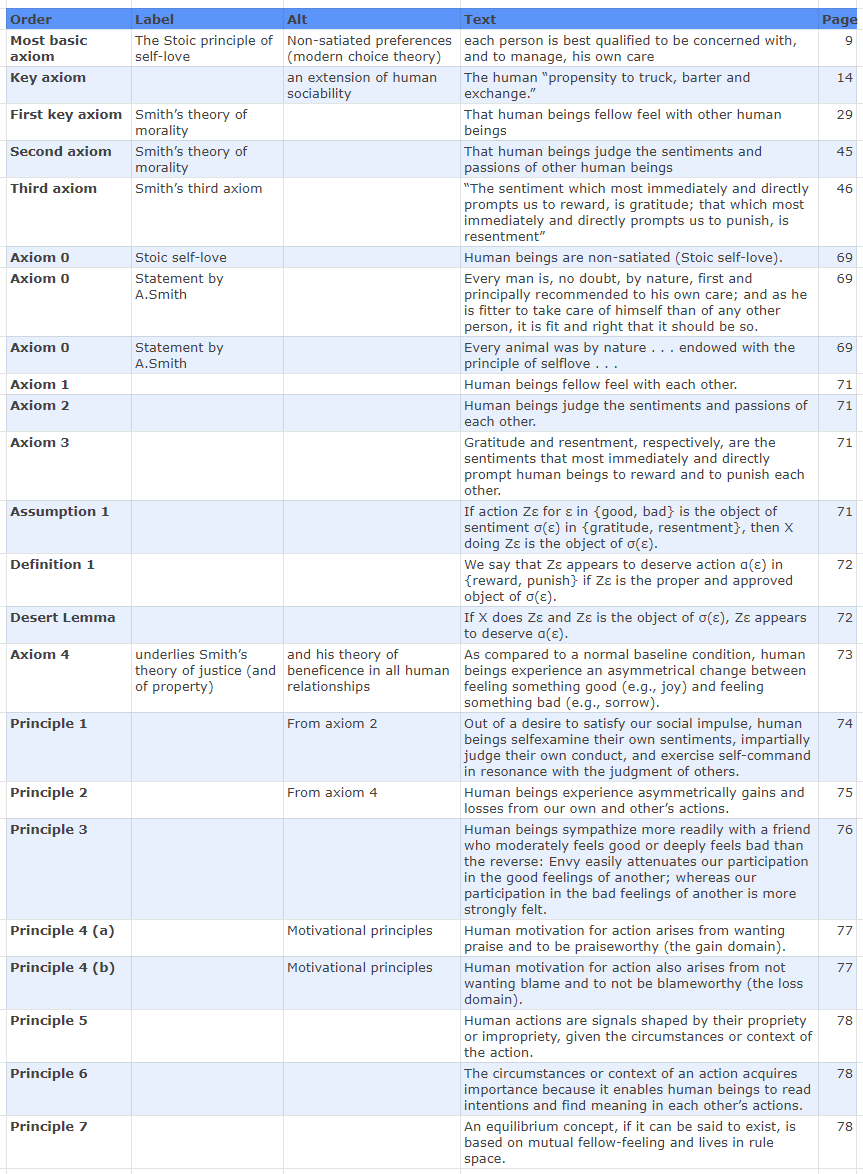
Smith and Wilson coded Adam Smith's ideas in a series of Axioms and Principles, summarized by Leonel Morales, "One aim in restating Smith's propositions as we do is to spell out the simplicity and universality with which he can be read".


Smith and Wilson proceed to analyze some classical games and see how these axioms and principles can explain the results, opposite to the failure of Max-U and behavioral economics. Finally they use Adam Smith's theory to predict the outcome of a new set of games. 

For the authors Adam Smith Theory of Moral Sentiments is a better model to explain how people interact. The analysis also closes the apparent gap between the Theory of Moral Sentiments and the Wealth of Nations. 
"His project in Sentiments is to address how moral conduct emerges out of human interactive experience to form a system of general rules that wisely order society. In Wealth he extends that system to markets and national economy to enable a better understanding of the sources and evolution of the economic order."

Wednesday, April 25, 2018

Why Nations Fail: The Origins of Power, Prosperity, and Poverty

Why Nations Fail: The Origins of Power, Prosperity, and Poverty Why Nations Fail: The Origins of Power, Prosperity, and Poverty by Daron Acemoğlu
My rating: 4 of 5 stars

Why Nations Fail is a contribution in the field of Development Economics. Daron Acemoglu and James Robinson elaborate a thesis trying to explain "why some nations are prosperous while others fail and are poor". Their thesis of the difference between extractive and inclusive institutions is intellectually appealing and provides a framework for a analysis of the chances for current states to improve. However they can't explain the emergence of these institutions and concedes that their existence is the fragil product of a Darwinian process.
"However, when a critical junction arrives, these small differences that have emerged as a result of institutional drift may be the small differences that matter in leading otherwise quite similar societies to diverge radically"
There are some fundamental ideas where I disagree with Acemoglu and Robinson. The first is the title itself. For a nation to fail it first had had to succeed. The natural condition of most human societies through history is poverty and some states have thrived and prospered. At present time more and more nations have progress, a shift in history that is not accknowledge in the book. This problem is fundamental because in some of the cases the description is incomplete and inaccurate. For instance what we now know as Perú was better than the north of America 500 years ago. It is correct that the USA is way much better than Perú, and itself 500 years ago; but Perú is also better today than Perú 500 years ago. Perú didn't fail, but it didn't succeed like the USA.
"Peru is so much poorer than Western Europe and the United States today because of its institutions... five hundred years ago the Inca Empire, which occupied contemporary Peru, was richer, more technologically sophisticated, and more politically centralized than the smaller polities occupying North America."
I also find the institutional framework problematic and incomplete. The thesis is that inclusive political institutions and economic institutions are the cause of prosperity. This creates a four state model, being inclusive-inclusive the best and extractive-extractive the worst. Combinations of extractive-inclusive and inclusive-extractive yield mixed results, sometimes short-term prosperity or eventual political collapse. So far the model is OK. If institutions are so important, why didn't Acemoglu deepen in what institutions are important? Maybe because they can't.
"The outcome of political conflict is never certain, en even if in hindsight we see many historical events as inevitable, the path of history is contingent."
It is up to the reader to try to figure out from the cases what common elements may define the correct institutions. On the political side Acemoglu and Robinson favor democracy and not so much rule of law. A unbounded democracy can easily turn into a tyranny of the majority (see following issue). Among the economic institutions they favor private property which is a very static concept and overlooks entrepreneurship and price system.

A third issue is the predictive power of the model. A theory that fits to the past but can't predict to the future is not strong. For instance, Acemoglu and Robinson picture Brazil, after its inclusive democracy, as a success story which is not. Democracy in Brazil switched the balance of power but didn't transform the nature of the institutions. Poor respect for property rights and rule of law left the door open to corruption and populism. The turmoil in Brazil in 2017-18 and many Latin American nations give some hope but reality is that agendas remain populist. The problem with the predictive power of the model is that it has no power.
"extractive institutions can be replaced by inclusive ones. But it is neither automatic nor easy. A confluence of factors,..., is often necessary..... In addition some luck is key, because history always unfolds in a contingent way." (emphasis is mine)
The model of virtuous and vicious circles are easy to agree with Acemoglu and Robinson. They provide an explanation of the inertia that prevents institutional changes and help sustain the status quo, while giving hope for positive change and a warning for the fragility of inclusive nations.
"The synergies between extractive economic and political institutions create a vicious circle, where extractive institutions, once in place, tend to persist. Similarly, there is a virtuous circle associated with inclusive economic and political institutions. But neither the vicious nor the virtuous circle is absolute."
As a friend, Michael Strong, says "given MIT economics' traditional neglect of institutions,... Acemoglu should be regarded as a hero relative to his peers". Overall Acemoglu and Robinson provide a model to build on. Why Nations Fail description of history, although not accurate, is a point of reference to discuss what changes truly make nations prosper.

View all my reviews

Sunday, June 26, 2016

A Brief History of Entrepreneurship

Joe Carlen book is History the way I wish I had in school. Instead of the disconnected list of events "A brief history of entrepreneurship" is a dynamic summary of human history since the first civilizations in Mesopotamia until the next frontier out of our planet, from the eyes of entrepreneurs and those pushing out the boundaries of the then current world.
"The transformation from rural agrarian to urban commerce took place during the Uruk period of Sumerian history, an era that began about 3,500 years ago."
The narrative of the book allows the reader to identify the birth of institutions we take for granted today. From the division of labor, the non-zero sum trade, financial instruments to fund explorations, the early corporation and merchant societies, accounting control, fiat money, etc. 


The book is mainly descriptive and not normative about entrepreneurship but it is easy to identify historic patterns. Carlen's sources make the book credible and a good reference to understand the systemic differences of motives and results. In periods like the early Sumerians and Phoenicians dominated more by City-States that had high commercial interaction progress excelled. In contrast periods with strong centralized governments like Romans and Medieval times the entrepreneurial spirit was limited to cronyism and corruption. No wonder why in the first kind entrepreneurs and merchants were in high esteem, while in the later were the lowest of the classes.

Chapter 4, An Enterprising Faith, is quite interesting under the light of the current geopolitical events. It describes the emergence and advancement of the Arab world in the VII century. Unified under Muhammad the Arabs expansion covered the Middle East, North Africa/Spain and parts of Central Asia. Despite it was a military conquest it was driven by mercantile concerns. The Muslim world was a remarkable pollinator. It expanded and advanced Greek scientific knowledge, made mathematical contributions like algebra, expansion of use of writing paper from China, silk, cotton, wool textiles from different regions, or African Coffee.

The Brief history has a space for Sumerians, Phoenicians, Egyptians, Greeks, Romans, Arabs, Chinese, Mongols, Western Europeans and their Imperial expansion to America, Africa, India and Asia, and the Colonist. Before the Industrial Revolution most of the benefits of the entrepreneurial spirit were limited to the regions that were thriving and not globally. The last part starts with the Industrial Revolution. Carlen misses the role of ideas in the change of pace of progress, something that Deirdre McCloskey brilliantly explains. Nonetheless he points out:
"However, prior to the Industrial Revolution, innovation in the form of disciplined scientific inquiry rarely intersected directly with the world of entrepreneurship. The original Industrial Revolution, that is, the one that occurred in Britain and peaked during the seventy-year period of 1760-1830, is when those worlds coalesced in unprecedented ways."

Carlen covers the modern era with short biographies of business tycoons from Abraham Darby (1678-1717) to today pioneers of the last frontier like Elon Musk, Jeff Bezos and Richard Branson. Including people like James Watt, Thomas Edison, the wrongly called Robber Barrons (check Andrew Bernstein's "The Capitalist Manifesto"), entrepreneurs in different parts of the world (China, Latin America, Africa, or Russia), the information revolution with Bill Gates, Steve Jobs and more.

Overall the "A Brief History of Entrepreneurship" is a good reference of how entrepreneurship and human progress go hand in hand. A window of the conditions that allow these ever present minds shine and make all our lives better.

My rating 4 stars.


Monday, December 7, 2015

The Frankenstein Candidate

Vinay Kolhatkar novel is set in a near future by the US elections of 2020. A multimillionaire, Frank Kenneth Stein, who decides to fund his own presidential campaign breaking with the traditional parties. Quite the opposite of a Donald Trump who has the money but not the brains, Stein has clear and consistent ideas, thus many time conflicting.

With a complex plot full of obscure characters the novel unfolds the worst crises in history due to the games politicians play. A game that they can't stop without burning themselves and therefor are willing to do whatever to keep the wheel spinning.

The democratic presidential candidate, Olivia Allen is facing as rival the Republican Vice-President Quentin Kirby but soon realizes who the real enemy is.

Olivia Allen is a iconic character; beautiful, successful professionally and socially. It is easy to identify with her honest will to improve the system. Her optimism about working hard and fix what needs to be fixed is appealing. It is easy to feel empathy for her struggle between facing these life challenges and saving her personal life. As many of us, she realizes that the task is paramount because it goes against the stakeholders of the system. Olivia's philosophical transformation is encouraging, a hope that if people decide to think and not just hope the system may change.

The Frankenstein Candidate is a work of fiction but also a believable future. If the political system doesn't overhauls itself, which is very improbable, the size of the next crisis can be unthinkable. With the size of national and local debts, the level of monetary emission, the choking regulatory framework, and the irrational obsession with climate change, the future of a world is not shinny. Can the system be changed from within or the chances are nil leaving the only hope on a third contender with clear ideas and the pockets to compete. 

Frank Stein campaigns around the ten commandment of government; "honesty, forbearance, temperance, respect, integrity, kinship, courage, justice, dignity and humanity". This could be a model to measure how good or bad is a proposal since most of the politician promises fail on several of them. Overall these commandments are just traits of humanity.

Nice novel for the times. Now that we have elections in different parts of the world and many are about choosing the least bad.

My rating 4 stars

Sunday, December 6, 2015

Omnipotent Government

Ludwin Von Mises wrote Omnipotent Government in 1944 at the last days of WWII. Mises describes the philosophical grounds of the Nazi movement. A book rich in history background and a though provoking plan for the future.

In the first part Mises explains the German Liberalism during the middle of the XIX when the ideas of the classical Liberalism were partially adopted in Germany. According to Mises:
"At about the middle of the nineteenth century those Germans interested in political issues were united in their adherence to liberalism. Yet the German nation did not succeed in shaking off the yoke of absolutism and in establishing democracy and parliamentary government."
Mises explains the history of Germany from the late XVIII to the early XX with a different point of view from the dominant Socialist Historians. Overall he shows how and why a powerful-educated German society fell into Nazism.
"The questions to be answered are not: Why did the bankers and the rich entrepreneurs and capitalists desert liberalism? Why did the professors, the doctors, and the lawyers not erect barricades? We must rather ask: Why did the German nation return to the Reichstag members who did not abolish absolutism? Why was the army, formed for a great part of men who voted the socialist or the Catholic ticket, unconditionally loyal to its commanders? Why could the antiliberal parties, foremost among them the Social Democrats, collect many millions of votes while the groups which remained faithful to the principles of liberalism lost more and more popular support? Why did the millions of socialist voters who indulged in revolutionary babble acquiesce in the rule of princes and courts?"
For Mises the German Liberals were unable to protect the principles and ideas that help them succeed. They saw Socialism and Nazism as temporary setbacks and never recognize the deep roots of Etatism. Soon Etatism armed with a strong military evolved into nationalism.
"As soon as liberalism reached Germany and Italy the problem of the extent of the state and its boundaries was raised. It solution seemed easy. The nation is the community of all people speaking the same language; the state's frontiers should coincide with the linguistic demarcations."
"The principle of nationality is an outcome of the interpretation which people in Central and Eastern Europe, who never fully grasped the meaning of liberal ideas, gave to the principle of self-determination. It is a distortion, not a perfection, of liberal thought."
The nationalism originally define as unity of language evolved  to unity of race. The idea that Germany was the strongest among European nations contrasted with the defeat after WWI and the unacceptable conditions of the Versailles Treaty. It fueled the legend of "the stab in the back" followed by the total failure of the Weimar Republic setting the conditions to the advent of Nazism. The party sold itself as the enemy of the communist to the liberals and as saver of the poor from the bourgeois. But overall a saver of the German Nationalism, nationalism now defined by race with a common enemy, Jews.

Mises' conclusion can be read two ways. Considering the era when The Omnipotent Government was published he recognize the improbability of a liberal world, necessary to discard aggression from other countries, plus the risk of government to close their borders establishing autarkic states and starting aggression against their neighbors to eliminate its dependency. 
"But will all men rightly understand their own interests? What if they do not? This is the weak point in the liberal plea for a free world of peaceful coöperation. The realization of the liberal plan is impossible because—at least for our time—people lack the mental ability to absorb the principles of sound economics. Most men are too dull to follow complicated chains of reasoning. Liberalism failed because the intellectual capacities of the immense majority were insufficient for the task of comprehension."
But sixty years later we can read his conclusion as a kind of prophecy of how humanity is condemned to live with the risk of war supporting strong armies as long as the different flavors of etatism are not replaced by liberalism, where goods and people move freely anywhere in the world.

Is capitalism an all or nothing global condition for peace? Are global coalitions and governments the only defense to totalitarian neighbors?

This book was the subject of the 2015 Socialism Seminar organized by the Center for the Study of Capitalism at Universidad Francisco Marroquin.

My rating 4 out of 5.