Saturday, April 21, 2018

Vida y magnicidio de Carlos Castillo Armas

Una pausa en mi proyecto de lectura del 2018, "Vida y magnicidio de Carlos Castillo Armas" de Rolando Girón Romero. El libro, que es la publicación de un trabajo de investigación académica (tesina) me llamó la atención por razones personales. 

Como indica Carlos Sabino en el prólogo "Rolando Girón ayuda por eso, con esta investigación, a aclarar un tema que todavía está pendiente para la historiografía guatemalteca."

El hecho que un magnicidio no haya sido debidamente investigado llama mucho la atención cuando en otras latitudes eventos similares han alimentado desde científicos serios hasta teóricos de la conspiración. A su vez no sorprende en Guatemala, siendo este un país donde verdades a medias satisfacen la ignorancia y la mediocridad. Casos más recientes como Gerardi y Rosemberg, aunque con más cobertura que Castillo Armas, podrían servir de ejemplos.

La redacción del texto podría ser mejor, algo que Girón tendrá que evaluar si quiere continuar escribiendo, aunque él mismo explica que la investigación es producto de una vieja inquietud. Como historiador dedica una buena parte del libro a dar un contexto a las hechos. Cubre tanto la historia local como el panorama mundial que sin duda influyó en lo sucedido la noche del 26 de julio de 1957.

Uno de los méritos más grandes del trabajo de Girón fue localizar el informe forense de la autopsia realizada a Castillo Armas y al soldado Romeo Vásquez Sánchez . Informes que ponen en entredicho la sobre simplificada versión oficial.

Girón se detiene hasta donde su curiosidad académica queda satisfecha y evita entrar en hipótesis de qué fue lo que realmente sucedió. Da suficientes argumentos para alimentar varias vías de investigación pero queda en deuda con el lector al preferir dejar la tarea a alguien más 
"No cito en este estudio los nombres. pues podría considerarse una acusación contra ellos, lo que no es el motivo de este trabajo. Si alguien está interesado puede profundizar más en este tema y en su curiosidad histórica."
Lástima que Vida y magnicidio de Carlos Castillo Armas no se publicó hace unos años. Si bien es cierto, como dice Girón, que familiares de los personajes citados aún andan por este mundo sus relatos no dejan de ser de segunda mano. Puedo imaginar que una obra como esta hubiera animado a los sobrevivientes de la época a desempolvar sus recuerdos y aportar al debate.

Tuesday, March 27, 2018

The Self-Driven Child

The Self-Driven Child is an excellent book for parents worried about their children's future. 
"Parental anxiety isn't new. Parents have worried about their kids ever since having kids was a thing, but we believe it's worse now than before. Why? For one, we have a lot more information than we've ever had before."
I recommend "The Self-Driven Child" next to Madeline Levine "Teach your Children Well", and Alison Gopnik "The Gardener and the Carpenter". Books with supported research that help parents, and kids, enjoy themselves lowering anxiety and stress.
"Remember that your job is not to solve your children's problems but to help them learn to run their own lives"
"Your responsibility is to love and support your child. It isn't your responsibility to protect him from pain. You can't."
Stixrud and Johnson combine modern theory of neuroscience, positive psychology, and education, research references plus their own clinical practice experience along cases and practical advice. The first part of the book covers the theoretical foundation before getting into more actual problems like sleep, electronics and college.

In the end our goal as parents should be to love and enjoy our kids, to trust they will know how to get up on their feet and move along. And in the end, they will always come back when they need us.
"In a competitive, overly busy world, it's so easy to forget the basics: that enjoying your kids is one of the best things you can do for them, and for yourself."
"Teachers can teach, coaches can coach, guidance counselors can outline graduation requirements, but there's one thing only parents can do: love their kids unconditionally and provide them with a safe base at home."
The last section about college needs to be taken with a pinch of salt. If we assume p is the probability of succeeding after college and (1-p) the probability of not succeeding, and q the probability of succeeding without college and (1-q) is the the opposite. Stixrud and Johnson don't account if p>(1-p) and q<(1-q). Even the cases they develop show that succeeding without college is hard, maybe harder than succeeding in college. Yet succeeding in college by no means equals a happy life. If parents lower their expectations about their kids going to college they should acknowledge that a support system for their kids increases their chances. Considering that some college is the same as no college, the book check-list to evaluate if kids are ready for college is quite valuable. I recommend also reading Bryan Caplan "The Case Against Education", it complements what Stixrud and Johnson say. 

My rating 4 stars.

Thursday, February 1, 2018

The Awakened Family

A good idea buried in rubbish.

I became interested in Tsabary after an invitation to one of her conferences. Trying to become familiar with her work I watched her TEDx talk in SF and an interview with Oprah Winfrey. Her thesis about changing the idea of perfect parenting for self-improvement through our interactions with our children is right on. Even more when combined with mindfulness to be aware and sensible to the moments parents get hooked in power struggles with their children. However, I read her book just to be disappointed.


To begin with, Tsabary's hubris is overwhelming. Not many authors sign their book with their degrees - PhD. Is this a sign of what is inside? Being a scientist (assuming the degree from Columbia means a training in the science) the reader would expect some intellectual humility. Isaac Newton said "if I have seen further it is by standing on the shoulder of giants". Not for Tsabary. In spite of many of her ideas can be tracked to other people's work the books have no references, no mentions of anyone but her and her patients. The ideas in the book can be track to intellectuals like Freud, Csikszentmihalyi, Kahneman, Branden, Nietzsche, Baumrind, Pinker and the evolutionary psychologists, and more. She does not claim that the ideas are original but the omision speaks for itself.


Tsabary's work is not only unoriginal but contradictory. For instance she blames the parenting errors to the ego, but also advices that if parents do not care for themselves little can be done; Ego-Self long debate which Tsabary ignores and oversimplifies like in.
"The key to conscious parenting is to become aware of our ego, this persistent voice in our head, and its false ways. To parent well, it is imperative that we realize the ego isn’t who we are."


Tsabary's idea is to "re-educate" the ego. The ego is emotional, impulsive. By being aware we use our reason. In other words her advice can be summarized using Kahneman's terminology as making system 2 take control before relying on system 1 to respond in automatic but more coherently with our values.

Finally, irritating and bad science is her generalization of bad parenting. Maybe from her own experience as a mother and clinical psychologist she considers that all parents are dysfunctional, victims of their own parents, ill-fated, unable to have moral judgment and exercise their free will to be better. At times the book makes the reader feel overwhelmed; I'm such a bad parent. Human contradiction show up in all spheres; work, love relationships, leisure, education, etc. yet we keep moving forward improving. Why is parenting different? Tsabary's rhetoric resembles some religions by making people feel bad before taking the salvation ace under her sleeve.

Wednesday, December 20, 2017

Courage to Grow

Courage to Grow is personally relevant because I'm part of the story. Laura Sandefer shares her experience along her husband, Jeff, in founding and moving Acton Academy from an idea to an international success. As she clearly discloses the book is not a how-to or a treatise of Educational theory. It is a beautiful personal story full of challenges, successes, discoveries and hard moments, but overall it is an inspiring story for those willing to do something to change how kids are educated and raise these days.

Laura shares how they decided not to sign their kids in a traditional school after attending a Montessori school. The Sandefer's dilemma echoes with our own of not accepting the fact that the only option was putting our kids in a traditional school. 

In opposition of the traditional approach of Education where results, grades, titles and degrees are what matter, the Sandefer's wondered "Can a vision of school rationally encounter the power of love and claim it?" and they didn't stop at the question and moved forward and made Acton Academy a reality.

Acton Academy was quickly recognized as an alternative to the traditional system. It's differentiation is "Our biggest point of separation is the upside-down power structure that pushes control and decision making to the children." Indeed what I value the most about Acton Academy is that children became responsible of their own Education and life. 

"A month after their visit, Juan had already found families (we were one of them) who would enroll their children. And with that Acton Academy Guatemala City began to take shape."

Acton Academy is an evolving community that has extended world-wide. It is not a simple franchise system but a sharing of values and principles that anchor a joined effort to improve the education of our kids.

Thanks to Jeff and Laura, Juanma and Analu for trusting the children and taking the lead.

Thursday, November 30, 2017

Tractatus Logico-Philosophicus

Considering the complexity of Tractatus Logico-Philosophicus, it is amazing that Ludwig Wittgenstein wrote it in the trenches during WWI. The only book published while he was alive, depicts a young philosopher's concern with the problem of the science. Although he later dismissed this work, Tractatus remains an important text in its field. Even though I don't agree with Wittgenstein nihilism, but his ideas in this book are important for the discussion about psychology, epistemology, ethics, language and philosophy.

This text is Wittgenstein's critique of philosophy 
"Philosophy is not one of the natural sciences.... Philosophy is not a body of doctrine but an activity". 
In Tractatus Wittgenstein makes an equivalence of reason and symbolic logic - no errors. "Though can never be of anything illogical, since, if it were, we should have to think illogically." This follows that if language follows the same rules of symbolic logic, reasoning would be error free.

Later, Wittgenstein establishes an analogy between language and pictures as representations of reality, "A picture is a model of reality". A reality that is comprised of facts, not things. The world is made of facts, events, not things. 

For the young Wittgenstein what counts is a thorough logical construct of propositions and operators, a general form of truth-function as he called it. 
"The proof of logical propositions consists in the following process: we produce them out of another logical proposition by successively applying certain operations that always generate further tautologies out of the initial ones." 
It doesn't need to be validated with reality. How could one validate a proposition with reality if we can't know reality? We just can check their logical soundness. The problem why we seem to make mistakes is that our languages are not solid enough. 
"In order to avoid such errors (one sign with multiple significations) we must make use of a sign-language that excludes them by not using the same sign for different symbols and not using in a superficially similar way signs that have different modes of signification: that is to say, a sign-language that is governed by logical grammar"
The conclusion is that we must thrive to use coherent, unequivocal language to represent reality. If sign-language is complete, all the world can be coded.

Did I understood Wittgenstein? I don't know. But as he says in his opening paragraph and close to the end:
"Perhaps this book will be understood only by someone who has himself already had the thoughts that are expressed in it."
"My propositions serve as elucidations in the following way: anyone who understands me eventually recognizes them as nonsensical, when he has used them - as steps - to climb up beyond them. (He must, so to speak, trow away the ladder after he has climbed up it). He must transcend these propositions, and then he will see the world aright."
Later in life Wittgenstein seems to recognize and accept the limitations of language and gives up the ideal of such perfect code in exchange of an ordinary language philosophy. 

What we can all take from Tractatus Logico-Philosophicus is his very last proposition 
"What we cannot speak about we must pass over in silence." 
In today's world so many people pretend to be experts that we need more silence, more reflexion, more reason.


Monday, November 20, 2017

Time Machine

A few days ago I saw a video of an interview between Camille Paglia and Christina Hoff Sommers at the Independent women's forum may 16, 2017. In it Paglia discusses with Hoff Sommers the current debacle of feminism in western world. In the conversation Paglia makes reference to one of her favorite movies as teen, "The Time Machine (1960)". After watching the movie I decided to go for more and read the whole book.

H.G. Wells published The Time Machine in 1895, twenty years before Einstein's General Theory of Relativity. Although not a formal scientific treaty but a science fiction novel, The Time Machine plot is rich in modern science ideas that popularized traveling in time.

As many book made movies there are important differences in the plot yet both share some of the key ideas.

In Time Machine, H. G. Wells narrates the story of a Time Traveler from the point of view of his curious friend, probably named Hillyer. The Time Traveler is an inventor and adventurer who has an interesting theory about time.
"There is no difference between Time and any of the three dimensions of Space except that our consciousness moves along it."
For him time travel is possible if one moves in that dimension, thus no change of Space position. As an inventor he shows a scale prototype to his visitors and most of them leave skeptically, Hillyer curiosity makes him go back just to find that the Time Traveler had a full scale device he later used to travel to the future.

In a later scene the Time Traveler returns beaten and in rags finding his friends sitting at the dinner table. After having some food he start telling the story of what happened during his trip to the future.

The most relevant part, adapted by the movie, is his stay in C.E. 802,701 when he faces two human descendant species, the Eloi and the Morlocks. The later are ape like carnivorous who live Under-world, while the first are "beautiful and graceful creatures, but indescribably frail" who lived Upper-world without major worries but who end up being a sort of cattle for the Morlocks.

The Time Traveler was optimist before his trip "I had always anticipated that the people of the year Eight Hundred and Two Thousand odd would be incredibly in front of us in knowledge, art, everything." but after meeting the Eloi "For a moment I felt that I had built the Time Machine in vain." There are more similar references, like his poor preparation with tools thinking that in the future technology would be much better.

Wells description of the Eloi resembles the critique of Paglia and Hoff Sommers
"where population is balanced and abundant, much childbearing becomes an evil rather than a blessing to the state; where violence comes but rarely and offspring are secure, there is less necessity - indeed there is no necessity - for and efficient family, and the specialization of the sexes with reference of their children's needs disappears. We see some beginnings of thi even in our own time, and in this future age it was complete."
Although the Time Traveler was wrong in his theory his description of the dystopian future resembles what extreme groups are aiming for.

Should we be pessimists as the Time Traveler and Paglia or optimists as the narrator?
He, I know thought but cheerlessly of the Advancement of Mankind, and saw in the growing pile of civilization only a foolish heaping that must inevitably fall back upon and destroy its maker in the end. If that is so, it remains for us to live as though it were not so.

Wednesday, November 8, 2017

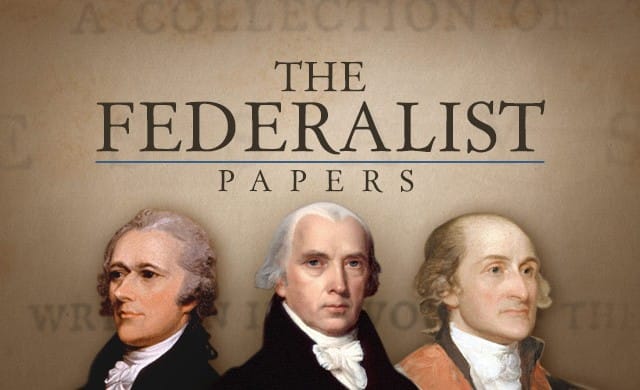
El Federalista (The Federalist Papers)

Thomas Jefferson pensaba que los niños debían aprender a leer con libros de Historia. El Federalista o “The Federalist Papers” cómo se les conoce en inglés son una colección de artículos publicados en New York previo a la ratificación de la nueva constitución de EUA en 1789, la mejor y más duradera constitución del mundo moderno. Escritos por James Madison, Alexander Hamilton y John Jay estos artículos explican con claridad el razonamiento detrás de la constitución. Dentro de los artículos los de Madison destacan por su claridad filosófica. Hamilton es hoy más popular y tiene una posición más inclinada a favorecer un gobierno federal fuerte. 

No todas las ideas prosperaron y no todas eran igual de buenas para establecer las bases de una República. Sin embargo, siguiendo el consejo de Jefferson, El Federalista es una lectura obligada hoy que muchos de los valores que la Constitución defienden se han puesto en duda y tergiversado. 

Un buen cierre de la lectura sería la advertencia de Benjamin Franklin cuando le preguntaron que habían hecho “una República si la pueden conservar”

>>>>>>>>>>>>>>>>><<<<<<<<<<<<<<<<<

Thomas Jefferson thought that kids should learn to read reading History books. The Federalist Papers is a collection of articles published in a New York newspaper before the ratification of the US Constitution in 1789, the best and longer lived constitution in the modern world. Written by James Madison, Alexander Hamilton and John Jay this columns explain with clarity the rationale behind the Constitution. Within the articles, Madison's outstand thanks to his philosophical clarity. Hamilton is currently the most popular of the three and has a position more incline in favor of a strong central government.

Not all the proposals thrived and not all were equally good to set the foundation of a Republic. However, following Jefferson's advice, The Federalist Papers are a must read today that many of the values that the Constitution defend are questioned and distorted.

A good closing for the book would be Benjamin Franklin's answer when he was inquired of what they did "A Republic if you can keep"