Thursday, December 19, 2019

Systems of Survival

Jane Jacobs is better know by her book "The Death and Life of Great American Cities" but Systems of Survival is her masterpiece on morality. 

Different from her previous work Systems of Survival is written as a dialogue which is interesting in itself. Each character represent a different point of view and together they develop, through a series of socratic dialogues and research, a moral system that answers the initial quest of a systemic thinking about morality in practical working life. 

Jacobs calls these frameworks syndrome not as a type of illness but "it comes from the Greek, meaning 'things that run together'. We customarily use it to mean a group of symptoms that characterize a given condition." In other words these systems represent a whole set of precepts to address how people solve their living problems.

"My hypothesis is that we have two contradictory ways of getting a living; therefore we have two contradictory moral syndromes, one to suit each way and its derivatives."
"I've come to think of the two moral syndromes as survival systems, worked out by long experience of with trading, on the one hand, and taking on the other"
These syndromes are the Guardian and the Commercial

Moral Precepts
Guardian SyndromeCommercial Syndrome
  • Shun trading
  • Exert prowess
  • Be obedient and disciplined
  • Adhere to tradition
  • Respect hierarchy
  • Be loyal
  • Take vengeance
  • Deceive for the sake of the task
  • Make rich use of leisure
  • Be ostentatious
  • Dispense largesse
  • Be exclusive
  • Show fortitude
  • Be fatalistic
  • Treasure honor
  • Shun force
  • Compete
  • Be efficient
  • Be open to inventiveness and novelty
  • Use initiative and enterprise
  • Come to voluntary agreements
  • Respect contracts
  • Dissent for the sake of the task
  • Be industrious
  • Be thrifty
  • Invest for productive purposes
  • Collaborate easily with strangers and aliens
  • Promote comfort and convenience
  • Be optimistic
  • Be honest

For Jacobs both systems or syndromes are natural and needed. However they can be corrupted by crossing the boundaries that separate them. Through a historic analysis the characters uncover these two syndromes, how the corruption made them fail and how has societies kept them separated.  Historically, to keep the two syndromes confined and moral integrity, we either use a cast regime or a rational moral flexibility. The group lean for an imperfect moral flexibility over the cast system.
"If it is true we're the only creatures with two fundamentally different ways of getting a living, it follows that to be as fully human as we can be, we should all be capable of using our two syndromes well. They belong to all of us because we are human, no other reason." 
"Every normal person the world over is inherently capable of both trading and taking..... But knowing when it's appropriate to use the one or the other approach, trading or taking, and how to do it properly - those things are culturally learned, mostly by imitation and practice."
Jane Jacobs' conclusions of Systems of Survival is that "the guardian-commercial symbiosis that combats force, fraud, and unconscionable greed in commerce life - and simultaneously impels guardians to respect private plans, private property, and personal rights. ... Perhaps we have a useful definition of civilization: reasonably workable guardian-commercial symbiosis"

Wednesday, December 18, 2019

Progress

Johan Norberg offers a recount of how the world is much better today than anytime in history. Progress covers different facets of human life. 

  • Food 
  • Sanitation
  • Life expectancy
  • Poverty
  • Violence
  • Environment
  • Literacy
  • Equality
  • Childhood (Next generation)
In all of these Norberg lays out evidence on how, thanks to values of the Enlightenment and their implementation in capitalism and liberalism, life has dramatically improved. Only this system allowed amazing progress  while sustained a huge population growth.
"Between 1950 and 2011 world population grew from 2.5 to seven billion. This did not happen because people in poor countries started breeding like rabbits, as people sometimes assumed; it happened because they stopped dying like flies. But it did not take long until families started adapting. As parents came to realize that their children were less likely to die young, they stopped having as many babies."
There are still battles to win but instead of turning our backs to the causes of progress we should defend and embrace them.

Progress is a book about optimism, its Johan Norberg's invitation to move forward instead of sit to complaint and cry.

Monday, December 16, 2019

Permanent Record

Permanent Record by Edward Snowden

"The closest thing to science fiction I've ever seen in science fact" - Edward Snowden

Friday, November 29, 2019

The Future of Humanity

Michio Kaku is a physicist better know as a popularizer of science after his multiple TV shows, digital media presence and nine books. The Future of Humanity is his latest work (2018) and is a futuristic effort placed way ahead in the future.

With such long time frame, Kaku can speculate anything, but he cleverly connects it with the ideas of the present. This is the main take away from the book.

On one side The Future of Humanity is about unthinkable dreams, on the other the challenges that the laws of physics impose. "there is one thing that even alien civilizations will have to obey, and that is the laws of physics." 

With these yes-but and what-if games Kaku takes the reader to the farthest spots in the universe while explaining why leaving Earth is not as easy as Hollywood makes it seem.

The starting point of The Future of Humanity is that our species "sooner or later will face global crises that threaten our very existence", and hence we have the incentives to migrate to outer worlds. Despite the hazards that we may face, Kaku consideres the drive to adventure and exploration part of the human nature. Is it? maybe not but we can't ignore that we don't need the whole species to agree. with just a few entrepreneurs (i.e. Elon Musk, Jeff Bezos, Richard Branson) suffice. How difficult interplanetary transportation really is? How soon will it occur? How can it be, physically or just pure information? It is almost impossible to speculate about these questions without entering into more philosophical questions like what is consciousness  "Consciousness, I claim, is the process of creating a model of yourself using multiple feedback loops—for example, in space, in society, or in time—in order to carry out a goal."

For Kaku the Future of Humanity depends on our own civilization evolution. Unless we reach at least a Type I Kardashev civilization level intergalactic travel is only a dream. A Type I civilization will require new organizational rules. Our current models are incapable of such challenges. Kaku concurs with Elon Musk when he said:
"Elon Musk has speculated that, as civilizations master advanced technology, they develop the power to destroy themselves and that the biggest threat facing a Type I civilization may be a self-inflicted one."
The Future of Humanity has an optimistic tone. The broad range of innovations in healthcare, communications, energy, etc. that we see today are the seeds of a future that is still only possible in the minds of these futurists and entrepreneurs. Are we going beyond the limite of how much resources we can dedicate to a single quest? Kaku doesn't answer key questions like who will coordinate the necessary efforts? A global government? Who will pay of it? Not even the ultrarich have enough, is tax-payers money involved? What about other day to day priorities like deseases, poverty, etc. Who is going and who is staying? Who is up to decide? Is it wise to spend huge amounts of resources and energy in these endeavors?

Is The Future of Humanity to please the masses or is it a book to take seriously? Time will tell. 

Tiempos Recios


Tiempos Recios es una novela histórica ubicada en Guatemala del principio de la segunda mitad del siglo XX. La proximidad histórica, geográfica y personal a los hechos que dan marco a la novela sumado a la reconocida calidad de Mario Vargas Llosa la hace interesante de entrada. 

Literariamente, Vargas Llosa cuenta una historia rica en personajes, detalles, con movimientos bruscos de tiempo que a veces confunden al lector, pero no tanto como para asustarlo mas para mantenerlo conectado. Sobresale el esfuerzo del autor peruano por usar modismos chapines lo que hace que la historia sea aún más sensacional.

Tiempos Recios es más la historia de Martita Borrero la Miss Guatemala que nunca fue y del dominicano Johnny Abbes, operador del dictador Trujillo. Dos vidas complicadas que se cruzan con un interés común. La historia del Coronel Jacobo Arbenz, de la mal llamada Primavera Democrática, del movimiento de Liberación Nacional y el Coronel Carlos Castillo Armas, y la United Fruit Company van construyendo el laberinto por donde se desenvuelven las vidas de los personajes.

Si bien es cierto que Vargas Llosa hizo su tarea por entender los hechos de la época, él mismo aclara que no es su intensión narrar la historia como hechos verídicos. Es así que Tiempos Recios no es una respuesta al debate de lo que realmente ocurrió en Guatemala en aquellos años. No se puede negar la situación general del juego geopolítico de la época. Siendo una historia bien hilvanada y en un contexto próximo es fácil caer en la tentación de creer todo lo que dice. Según se sabe lo que entusiasmó a Vargas Llosa con la historia de la Guatemala del medio siglo XX fue su conexión con Trujillo y la posibilidad de hacer una especie de secuela de La Fiesta Del Chivo. Es comprensible que prefiera las teorías que refuerzan esta conexión. Para más información ver  Vida y magnicidio de Carlos Castillo Armas de Rolando Girón Romero.

Tiempos Recios nos recuerda lo complejo que fueron aquellos años, pero no por ello debemos olvidar que es una novela y por lo mismo Mario Vargas Llosa tiene licencia para llenar con creatividad los vacíos históricos, de elegir las interpretaciones que más ayuden a la trama e incluso a cambiar los hechos para mantener al lector pegado al libro. 

Wednesday, November 13, 2019

Humanomics

Vernon Smith, Nobel prize winner 2002, and Bart Wilson are renowned experimental economists. They faced an apparent contradiction when neoclassical utility maximization or Max-U model, that explained perfectly well supply-and-demand market experiments, failed in two-person games. Behavioral and experimental economists explained the differences ex-post as "social preferences".

Humanomics is a neologism in reference to the study of the human problem as both personal social and impersonal economic.

Morality is an emergent order based on the will of the people to seek praise and praiseworthiness and avoid blame and blameworthiness. "In Adam Smith's model of human social conduct, actions are governed by context-dependent rules based on experience and human capacity for mutual sympathetic fellow-feeling". In other words, humans have the capacity to extract the accepted rules by observing and feeling others around.

None of the authors, including Adam Smith, are experts on play but it is striking how they recognize and fit the role of play in children to understand the moral rule set.
"The child naturally wishes to gain their favour, and to avoid their hatred or contempt... and it soon finds that it can do so in no other way than by moderating, not only its anger, but all its other passions, to the degree which its play-fellows and companions are likely to be pleased with."
The capacity to understand the moral rules is context free but the rules in themselves are context relevant. Societies flourish when that mutual support is provided in the reciprocity of gratitud and friendship bound together in good offices of affection and esteem". Societies thrive when their rules promote cooperation, exchange and mutual respect.

One key takeaway from Humanomics is that human behavior follows some general rules on how rules are set, yet the specific rules are different based on time and context. Therefore, we can't use the same rule set to evaluate two different results. But we can identify some common denominators in functional system vs dysfunctional ones.
"When dealing with human beings, we must get comfortable with the imprecision of our humanity"
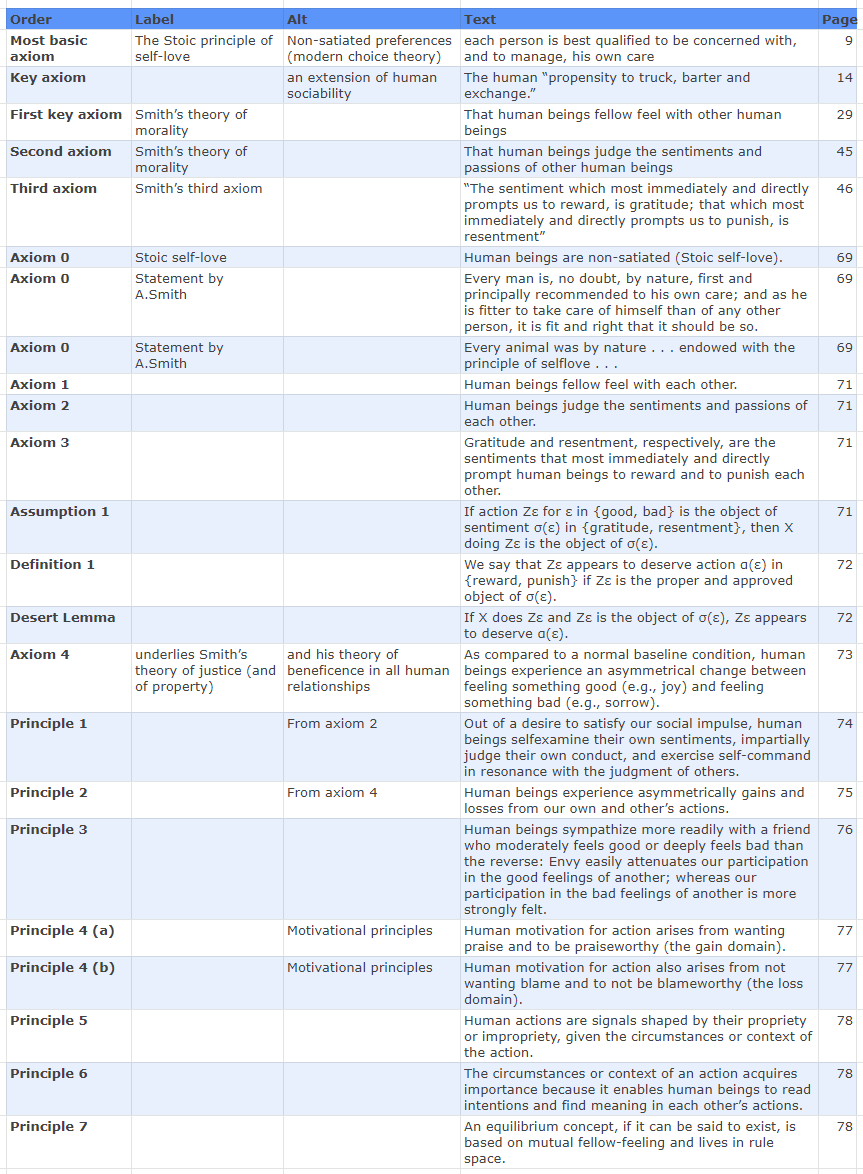
Smith and Wilson coded Adam Smith's ideas in a series of Axioms and Principles, summarized by Leonel Morales, "One aim in restating Smith's propositions as we do is to spell out the simplicity and universality with which he can be read".


Smith and Wilson proceed to analyze some classical games and see how these axioms and principles can explain the results, opposite to the failure of Max-U and behavioral economics. Finally they use Adam Smith's theory to predict the outcome of a new set of games. 

For the authors Adam Smith Theory of Moral Sentiments is a better model to explain how people interact. The analysis also closes the apparent gap between the Theory of Moral Sentiments and the Wealth of Nations. 
"His project in Sentiments is to address how moral conduct emerges out of human interactive experience to form a system of general rules that wisely order society. In Wealth he extends that system to markets and national economy to enable a better understanding of the sources and evolution of the economic order."

Wednesday, October 23, 2019

The Relationship Economy

The Relationship Economy is an interesting book, nonetheless a mix of Customer Service ideas and DiJulius Group advertising. 

DiJulius highlights the importance of customer relationship in all facets of business; customers, employees, leadership,  human interaction in general.

Some ideas worth highlighting are the importance of service as a true differentiation factor. Most vendors of any product or service meet pretty well the requirements of the market, hence what becomes the true loyalty driver is service. 
"Customer Loyalty is a result of the multiple micro-experiences a person has with a brand. It reflects the fact that not only is that business consistently brilliant a the basics, but also that it has taught all its employees to be present in the moment at each of its touch points." 

Another one is the FORD (Family, Occupation, Recreation, Dreams) technique as a tool to foster relationships.  "FORD represents people's hot buttons, what each individual cares about the most. FORD is what they are passionate about. It is the topics that make them light up."

A corollary of the FORD technique is accepting Kalina Silverman   invitation to skip the Small Talk for the Big Talk to connect with anyone. 

Some closing remarks worth sharing: "World-class service is not something you do or deliver; it is something that is in you, in all areas of your life".

Saturday, July 20, 2019

Unschooled

Reading Kerry McDonald's Unschooled reminded me my early years as a parent. Despite not being satisfied with the educational system, we accepted with resignation that we had no option for our kids. We tried to choose the "best" school, however mostly the differences were the quality of the people leading the schools and their teachers. Even a friend tried to convince us to home-school our kids but we felt it was the same (school at home) minus the "socialization". Years later we were invited by another friend to join an alternative school, an off-the-system project. It was a challenge because people around us opposed and voiced their opinions with comments like "you are going to ruin your kids lives", and so. The project was worth, not because of pure opposition to the mainstream, but being off-the-system allowed them to offer a truly student center project with mixed ages, learners community, no-grades, no-homework, etc.

All this process was scary because we had no reference beyond the myth of schooling, the same myth we grew up with and we have survived!!! Was this our tantrum against the system and our kids were going to pay the price? The problems with the traditional schooling and the benefits of these new projects are well supported by theory and scholars yet little evidence was available to confirm that it works in practice. And this is where Unschooled fills the void. Using Kerry's own words 
"Schooling has become so engrained in our culture and conversation that disentangling it from learning takes time and though. Not only do we need to unschool our own thinking but also we need to help others do the same."
Unschooled is McDonald's "personal views and experiences related to unscholling and self-directed education" nonetheless it is very well documented. From John Locke to Peter Gray the breadth of references is a proof of the seriousness of her work. Along the theoretical references Unschooled offers a mosaic of real people's experiences doing what they believe is best for the kids. Unschooling is a movement that has its roots in the progressive reforms of the 1960's, it has reborn with a core difference "one refreshing change with today's unschooling movement is that it is being driven not by philosophers but by parents"

The book covers the history of unschooling, gives a definition and contrast it with schooling, and tackles some myths like; the curriculum, freedom is not license, appropriate ages to learn math or reading, and more. Also the book has a good diagnosis of the problems of the mainstream system and how it has worsen over the years despite efforts to fix it. Kerry McDonald is straight and honest in this respect "what we need conventional public schools to become if they are to truly move from a schooling paradigm to a learning one. They need to be built entirely from scratch."

In a later part of Unschooled, is a section with resources for unschoolers. From technology, resource centers, fab labs, maker spaces, libraries, revolutionary schools, apprenticeships, adventure playgrounds, and more. In summary this section is a window of options and an invitation to join and start a resource for our own communities. 

The last chapter is an outlook of the future of unschooling, which can be summarized in Kerry's call to action: 
"It all comes down to parents. It will be parents who decide whether or not we move toward an unschooled future. It will be parents who determine whether or not to reclaim their child's education."
The only subject I think the Unschooled is missing is the labor markets. As long as companies keep hiring by degree (the sheepskin effect that Brian Caplan describes in his book The Case Against Education) the unschooled future is riskier, specially for lower income families who can't rely on friends, connections, or family safety nets. There is some hope in this regard after some tech giants are dropping the diploma from their hiring process, but it is far from generalized practice. 

If you want to learn more about Kerry McDonald check her blog Whole family learning


Friday, June 21, 2019

Play to Live

Play to Live is a book for those who still haven't buy the importance of play for children and adults alike. If you know someone who still believes that play is a childish waste of time, give Brian VanDongen's book. 
"Play is not just important to education; play is education.  Play is not just important to a healthy lifestyle; play is a healthy lifestyle. Play is not just important to life skills; play is a life skill."
Without going into the depth of research on play this is a convincing invitation. Invitations to allow more play time to children and also to permit ourselves, as adults, to play.
"You have my permission: Be playful."

Children and Play in the Holocaust

Children and Play in the Holocaust is a emotionally hard to read essay by George Eisen. With a long list of references Eisen presents the experience of children in ghettos, detention centers and concentration camps during the Nazi occupation. These stories challenge the classical theory of play but also reinforce how play is so encoded in our genes that is almost unavoidable. 
"Play burst forth spontaneously and uncontrollably without regard of the external situation."
The sociological, psychological, physiological and even political aspects of life during the Holocaust are visited under the lens of children, and adult, play.
"Their play, just like all human experiences, was reflective of and governed by societal, psychological, and economic conditions of the society in which they took place."

For the people in the play field the book can be used as a catalog of play experiences to be classified under the 16 play types by Bob Hughes; to identify the play cycle and the role of adults in free play.

A River in Darkness

A River in Darkness is a surreal story of a man struggle to survive in North Korea. Half Japanese and half Korean, Masaji Ishikawa migrated to North Korea after his father got enticed by the lies of Kim Il-sung. For 36 years he struggle to survive to care for his family and see them die of starvation and abuse. He finally made it back to Japan just to find indifference and hostility. 

Among the lessons in the book is the eyewitness testimony of the failure of central planning (core of Socialism and Communism)
But that’s the thing. People in North Korea spend so much time in study meetings and calculating the number of hours they’ve worked that there’s no time to do the actual work. The result? Raw materials don’t arrive in factories, the electricity doesn’t work, and farms are overrun with weeds. But as long as people can get their food rations, they don’t care.
The black market was also thriving. It seemed the more messed up a country became, the more the black market prospered.

A River in Darkness is strikingly crude in the recollections of Ishikawa memories but also in the blind eye of other governments that wanted to avoid conflicts with North Korea, specially China and Japan itself. 
I often think about what would have become of me if I’d stayed in North Korea. I would probably have starved too. But at least I’d have died in someone’s arms with my family gathered around me. We’d have said our goodbyes. What chance of that now?
Ishikawa disappeared, don't know if publishing the book helped him in anyway. Don't even know if Masaji Ishikawa is his real name or a pen name. We just can hope he found peace.

Thursday, May 9, 2019

Exponential Organizations

In 1982 Tom Peters and Robert Waterman published In Search of Excellence, in 1994 Jim Collins and Jerry Porras published Built to Last, and in 2014 Salim Ismail, Mike Malone, Yuri van Geest came up with Exponential Organizations. What do these have in common? They are examples of what Jeff Sandefer call "Business Pornography". Or what Phil Rosenzweig in The Halo Effect calls Delusion of Rigorous Research.

Books that sold by the millions pleasing the ears of people looking for instant success stories.

Exponential Organizations (ExO) makes some good diagnostics of the differences in pace and dynamics in the market. However the book is about Unicorns a fact that the authors acknowledge "Most of Lee's unicorns score well above the ExO threshold score." 

A principle in finance is that the higher the risk the higher the returns, thus an ExO has very high returns because they have very high risks.The book misses the mark by oversimplifies the market, it doesn't say anything about the thousands who die trying to be unicorns, it has no recognition to elements of luck and opportunity. Somehow Ismail et. al. despise the old fashion business model of bootstrapping and hard-work is still valid.

In the end they come with the idea of an ExO mindset which should yield into a ExO company and X10 returns. Economically if this were true the market would be dominated by very few companies, all ExOs, or the market would be so huge that I doubt it would be sustainable. 

Near the end of the book Ismail et. al. quote economist Brian Arthur: "Complexity economics is a different way of thinking about the economy. It sees the economy not as a system in equilibrium but as one in motion, perpetually 'computing' itself - perpetually constructing itself anew. Where equilibrium economics emphasize order, determinacy, deduction and stasis, this new framework emphasizes contingency, indeterminacy, sense-making and openness to change. Until now, economics has been a noun-based rather than verb-based science." What Arthur call the old economics is what Economist like Pete Boetke call "Mainstream economics" that oversimplified an emergent process, in opposition to "Mainsteet economics" that has always been dynamic. Maybe the velocity has change but markets were never static. Therefore, Ismail's ideas are not that original, successful entrepreneurs and business-people have succeeded because they understood the dynamics of their time.

Saturday, March 16, 2019

Wise Guy

Guy Kawasaki returns with a book about life lessons that is entertaining, fun and yes, wise.

Wise Guy is a very personal book since he uses personal stories to give context to his pearls of wisdom. From the beginning Kawasaki clearly states:
"Before you ask, or wonder, this is not my autobiography or memoir. It is a compilation of the most enlightening stories of my life. Think personal lessons, not personal history."
Wise Guy is a collection of life lessons. We can learn from our own experience or vicariously from other people's experiences and this is what Guy has to offer: "my goal is to educate, not to awe you".

I'm not sure the order the author followed to write the book. He could have thought about a lesson to share and search for an anecdote to enhance or he could have remind a life event and search for lessons in it. Either way Wise Guy is a book loaded with nuggets of wisdom.

Some of the favorites ones are:
"Be a  hard-ass if you are a teacher, manager, coach, or someone who influences people. You’re not doing anyone a favor by lowering your standards and expectations in an effort to be kind, gentle, or popular. The future cost of  short-term kindness is great."
The world is full of PC-ness and being blunt and clear can be a risk worth taking. None wins from  hypocrisy. 
"Don’t consider yourself a victim... If you believe you’re a victim, you’ll truly become one.Take responsibility for your fate. You still may not succeed, but at least you’ll try."
This is a nugget consistent with other authors like Fred Kofman, Joseph Campbell and others. The victim has the benefit of not having to take responsibility but at a great cost, impotence and lack of freedom.
"Make your personal interests known. This provides “hooks” to develop additional and deeper relationships.  These relationships have led to friendships, adventures, and financial rewards. My life would have been a lot less interesting if I had not “opened the kimono” and unveiled my personal interests."
"Cultivate relationships with people you would run to see. Anyone who doesn’t pass the Shopping Center Test may waste your time, and life is too short. Second, be the person other people run to see. This is a useful test for how you treat others."
Living in a connected world is an opportunity to expand and grow. People are more than their jobs and sharing what you love can be a glue to support more and better relationships. But also the myriad of relationships can be overwhelming, Guy's advice is prioritize and spend your time wisely.
"If you provide value, you can ask  for—  and  receive— reciprocation. This is the glue that holds society together. You may not care about reciprocation, but the important concept is to help people so much that they would gladly reciprocate."
Adam Smith (and others before him) stressed the value of social cooperation. The division of labor works only in a cooperative environment. It is a mistake to think that competition is the opposite of cooperation, competition is the freedom to provide more value than others.You can't get value from society if you don't provide value, unless you are a parasite.
"Smile. The more you smile and laugh, the more you will smile and laugh. The more you smile and laugh, the easier life gets. You can never go wrong being nice, and there’s no such thing as being too nice."
This is one of the best ones. People live such dull lives that being playful seems as a sin or a crime (as Bernie DeKoven used to say). Believe in humanity and enjoy life more.

I found one of the last chapters, Ohana, quite special. Guy was humble and brave enough to ask his family and close acquaintances to share a pearl of wisdom they acquire from interacting with him. They share nice personal stories and what they learned form them.

Everybody should take the time to do what Kawasaki did with Wise Guy. Reflect on your life and what you learned, thank the people who touch your life and gave you a lesson, and ask those around you how you have made their lives better. 

Saturday, November 10, 2018

You, Your Child, and School

Sir Ken Robinson is a world wide recognized educator. Whenever Robinson speaks or writes something new the education community listens. This is the case of his latest book, You, Your Child and School. This time Robinson is speaking to the parents. Helping a generation of highly involved parents deal with the anxiety that educating their children in an increasing uncertain world.

Robinson's ideas are always stimulating and challenging, and hopefully this book will expand the discussion about the need for a radical change in Education.

However Robinson seems to still hope for the impossible, to change a government run education system. The coexistence of opposing models is a conundrum that has wasted millions of dollars while destroying the hope of families.

As a kind of social justice warrior Robinson sees an active role of public education as a menas to equality. His low trust in the profit motive probably biased by the current state of cronyism within the mainstream system blinds him to the efforts of thousands of edupreneurs who are trying to make a change. As Michael Strong points out here we need a free market of education for ideas to spur innovation. For many educators it is sinful to consider education for profit but as Kerry McDonald point it out here it seems to be a major reason why so many efforts have failed.

Aside from the political contradictions, Sir Ken Robinson delivers sound advice for parents who have understood that the current system of Education needs a turnover. 

It is satisfying that Robinson devoted some pages to the importance of play. 
"Perhaps the simplest advice I can offer parents concerned about preparing their children for the world is this: let them play more. I don't mean they should spend more time with the Little League or the school basketball club, as valuable as that can be. I'm talking about inventing games on the spot, with their friends, turning a pile of twigs into a faerie wood, or hiking along a stream to explore the wildlife there. Play is the work of a child, and children must have time, space, and permission to engage in variety of play in order to maximize the developmental benefits that play offers"
Then follows to elaborate on the definition of play by the "Dirt is Good - DIG" movement.

· Play is intrinsically motivated
· Play is a state of mind
· Play is pleasurable
· Play is nonliteral
· Play is actively engaging
· Play has no external rules

Another important advice from Robinson is how to judge a good school? He offers a template to make the call.
"As a parent you can use the four purposes and eight competencies as a template for judging whether your child's school - or your homeschooling program - is providing the kind of education they really need and press for improvements where necessary." 
The four purposes:
· economic development
· social development
· cultural development
· personal development

Learning to live (ways to know):
· know that
· know how
· know this

The eight competencies:
· curiosity
· creativity
· criticism
· communication
· collaboration
· compassion
· composure
· citizenship

Overall is a good book for parents, not so a contribution to the cause of an overhaul in Education.

Rating. 3 of 5 stars.

Saturday, November 3, 2018

La llamada de la tribu


"La llamada de la tribu" es el más reciente trabajo de Mario Vargas Llosa nos trae su biografía intelectual. Un recorrido por los principales pensadores que influyeron en su pensamiento liberal.

Adam Smith
José Ortega y Gasset
Friedrich August Von Hayek
Sir Karl Popper
Raymond Aron
Sir Isaiah Berlin
Jean-Francois Revel
(creo que Vargas Llosa debió agregar a Jean-Paul Sartre. Si bien es cierto que no fue un pensador Liberal, su presencia y desilusión son una constante)


Siendo Vargas Llosa un consagrado novelista, premio Cervantes (1994) y Nobel de Literatura (2010) entre muchos era de esperar un texto rico, entretenido y variado. "La llamada de la Tribu" es hasta cierto punto la continuación de "Contra Viento y Marea" (Entre Sartre y Camus, 1983) donde desarrolló su recorrido ideológico del socialismo al liberalismo. 

En esta oportunidad Vargas Llosa hace una reseña biográfica e intelectual de los autores liberales que más influyeron en su pensamiento. Por un lado nos cuenta detalles de sus vidas llegando a niveles de intimidad que acercan el personaje al lector. Detalles que no solo refieren sus virtudes sino sus defectos, haciendo de cada uno de los elegidos seres cercanos al lector. Ejemplos de estos sucesos están la disputa entre Karl Popper y Wittgenstein, o las infidelidades de Isaiah Berlin. Por otro lado, como buen escritor, no deja de hacer una crítica a la calidad literaria de sus héroes. Excelentes los textos de Ortega y Gasset y de Jean-Francois Revel, no así el inglés de Hayek. Pero la narración no es únicamente biográfica sino también intelectual. Vargas Llosa destaca los aprendizajes que tuvo de cada uno de los autores, pero también comparte lo que considera errores y contradicciones. 

Si bien es cierto que para alguien como Vargas Llosa escribir este libro es un lujo que se puede dar queda claro que todos podríamos emular la selección de nuestro "Dream Team" intelectual. Una selección que en forma indirecta esboza un perfil intelectual.

La riqueza del libro tiene un valor adicional al simple conocer mejor al Nobel, es un texto que puede bien servir de introducción al Liberalismo. Una narración donde resaltan algunos de sus principales exponentes y sus ideas sin llegar a ser un tratado académico pero si para sembrar en el lector dudas e interés por sus contribuciones individuales.

Rating 5 estrellas.


Thursday, June 14, 2018

Montessori: The Science Behind the Genius

Maria Montessori was an empiricist in many ways and her method developed from careful observation of children. In this book Angeline Stoll provides extensive research background to fill the voids of scientific support of the famous educational method.

In her book, Stoll addresses each of the eight principles of Montessori Education, providing support with specific research and expanded with actual Montessori practices. 

In most of the cases Montessori proved being in line with science, upholding the value of the method.


  1. Movement and cognition
  2. Choice and control
  3. Interest
  4. Motivation
  5. Collaborative learning
  6. Meaningful context
  7. Adult-child interaction
  8. Order and the environment

Stoll criticizes the traditional school system in different parts of the book, with a two-fold argument: The system is based on the Lockean view of the blank-slate mind; an empty container that needs to be filled with information (this is an oversimplification of Locke's view but the mainstream system seems to fit Stoll's interpretation). Thus, the system is organized for most efficient transmission as a manufacturing line. Maria Montessori recognized that children are born with dispositions to learn and each child is different, therefore the education method should facilitate that. From Stoll’s work we can conclude that Montessori is a superior education system than the standard offer for families and society.

However, there are a few issues to consider for further research.

Winning against the standard educational system is not a big challenge. Most of recent theories of how the mind works show that the empty vessel filled in a manufacturing line is plain wrong. The true contestants are innovative models that value the same principles as Montessori; such as Forest Schools, Free education (i.e. Sudbury School), unschooling, etc. However, this kind of research is hard to find since these practices are not widespread. Probably there is no right or wrong answer as different models satisfy different needs and tastes.

The value of research has some inherent flaws. Stoll is careful at explaining the limitations and through combining independent studies she ties in the conclusions. However most of these studies were made in school setting and as a play advocate once said; “studying children in schools is like studying wildlife in zoos”. Also, as Stoll quotes, “studying children in an environment that is not well prepared would be like trying to study normal cell growth in an infected petri dish”. There is a broad spectrum of Montessori implementations, how to know how the specifics degrees of preparedness of the cases affected the results?

From the play profession point of view, it is interesting the overlap between Montessori and play. However, Stoll explains that Maria Montessori had a limited understanding of play, reduced to toys that may sound opposite. 
“Dr. Montessori divided our hours into those for leisure and those spent at school. She implies that children may well choose to play with toys in their leisure time, just as we may choose to play chess, but that in the schools she structured, children did not choose to play.”
A more comprehensive understanding of play highlights the similarities. Using Peter Gray’s definition (Free to Learn). 
  1. Play is self-chosen and self-directed. This is coherent with the second principle of Montessori, choice and control. Play is an expression of freedom and Montessori give agency of learning to the child.
  2. Play is motivated by means more than ends. Play is activity conducted primarily for its own sake. Gray says “a playful student enjoys studying the subject and cares little about the test”, something very much related to the importance of personal interests and intrinsic motivation in Montessori. Same as grades, stars and rankings kill intrinsic motivation in education, turn free play into a competition.
  3. Play is guided by mental rules. Some of the critique to Montessori are its rules that Stoll explain is a balance that give freedom in some areas and structure in others. People need rules to operate either in play, school, society and work. In play children are agents in the definition of rules maybe more than in a Montessori school, but both offer way more freedom than traditional schools. This could be one of the areas of further research.
  4. Play is imaginative. Although Montessori discourage the use of fantasy in little children based on their inability to distinguish between fantasy and reality, creativity, play-pretend and sociodramatic elements of Montessori are based on the imagination of children. 
  5. Play is conducted in an alert but non-stressed frame of mind. The concept of flow is part of interest, context and even the purpose of what is the proper environment. 

The role of playworkers is quite similar of the role of the Montessori teacher, their goal is to disappear and just provide the right amount of clues to provoke children. Playworkers care for the quality of the playground as the teacher prepare the environment. Playworkers carefully observe the child at play just like the teacher observe the absorbent mind at work. And of course, the aphorism of Play is the Child’s Work is common to both. Of course, not everything is the same. For play advocates the affordances of items are important, the multiple uses that a person can give to a give object is discourage in Montessori classroom where each material is purposefully designed for a specific use.

It seems like children don’t find Montessori materials as alternative to toys but as engaging. Bob Hughes’ taxonomy of play (“Evolutionary Playwork”) can shed some light here.  A lot of the Montessori activities and materials can fit in some of the play types. 

Communication play is in the movable alphabet, sandpaper letters and other grammar exercises. Creative play is in the approach to science. Dramatic play and the understanding of how society works. Exploratory play and the multiple materials from the pink tower to the sound cylinders.  Mastery play is the end of Montessori three period lesson. Object play is the constant manipulation of objects such as the brown stairs, the red rods or the wooden cylinders to name a few. Recapitulative play is involved in the timeline of life or civilization. Role Play seems to be part of the appealing of Practical Life. Social play manifests in peer-to-peer and collaborative work and the mixed age groups. 

No wonder why kids can spend three hours of hard work; the program is structured as a flow of games where children enjoy enough freedom to manage their energy and attention. It is not hard to understand Maria Montessori’s reluctance about recess. In traditional schools, kids may be focused on an activity they enjoy as play and are forced to go out doing less interesting stuff. The pro-recess advocates critique the lack of freedom during breaks in traditional schools, it is not the same as in a well-run Montessori school. 

Finally advances in neuroscience could open a new door of research to connect the benefits of a Montessori method as well as all other alternatives that are popping and challenging the mainstream institutionalized education system. This could very well be the subject of another book but could provide the ultimate validation to the Genius.

Friday, May 4, 2018

Reality Is Broken: Why Games Make Us Better and How They Can Change the World

Reality Is Broken: Why Games Make Us Better and How They Can Change the World Reality Is Broken: Why Games Make Us Better and How They Can Change the World by Jane McGonigal
My rating: 5 of 5 stars

Currently we see everywhere from the news to the dinner table people complaining about video games and screens. What most people don't realize is that video games have been part of life for over 40 years. Many of the ones complaining used to spend hours at arcades or playing with early video consoles. Video games are part of reality and no matter how much we disagree they will not go away anytime soon. According to a Newzoo report "2.2 billion gamers across the globe are expected to generate $108.9 billion in game revenues in 2017".

Jane McGonigal is a game developer who shares her 10+ yrs experience developing video games. She explains how for gamers Reality is Broken because when they contrast their real life (school, work, etc.) and their virtual worlds they find in the later a lot of the values reality no longer provide.
"Gamers want to know: Where, in the real world, is that gamer sense of being fully alive, focused, and engaged in every moment? Where is the gamer feeling of power, heroic purpose, and community? Where are the bursts of exhilarating and creative game accomplishment? Where is the heart-expanding thrill of success and team victory? While gamers may experience these pleasures occasionally in their real lives, they experience them almost constantly when they’re playing their favorite games."
Games have some characteristics that are more or less common. A sense of purpose, a goal. They have rules that define boundaries and within unleash creativity and foster strategic thinking. Games have a feedback system that keep games engaged and motivated. Finally, McGonigal includes voluntary participation that is important for community formation. A fifth characteristic not included in the book is competition. Which is interesting because as later explained in the book, gamers are good at cooperation. Even in games that are about winning gamers find more motivation in collaborative modes.

McGonigal explains how game developers not only are good at games but have a better understanding of positive psychology and human motivation than most reality developers. Schools, companies, communities and even play spaces and parks miss those elements. No wonder when people have a choice digital easily wins.
“Game designers and developers are actively transforming what once was an intuitive art of optimizing human experience into an applied science. And as a result, they are becoming the most talented and powerful happiness engineers on the planet.”
But the most amazing insight is the power of Massive Multiplayer Online (MMO) Role-playing game (RPG). For instance, World of Warcraft gamers had spent over 5.93 million years solving challenges over the first six years. McGonigal proposal is to tap the power of MMO to tackle world problems. Not only local problems but those that require massive efforts such as pandemics, food supply, energy, network security, and migration. Through Alternate Reality Games - ARGs (ARGs are games you play to get more out of your real life, as opposed to games you play to escape it.)" players can bring all the good of video games to the real world.

Throughout the book, Jane McGonigal suggests 14 fixes to reality, in other words; how can we bring the excitement and motivation to our regular lives and more? With ideas such as:
"(Fix #2: Activate extreme positive emotions). That’s why games can put us in a positive mood when everything else fails—when we’re angry, when we’re bored, when we’re anxious, when we’re lonely, when we’re hopeless, or when we’re aimless.” 
“We’ve discovered how game designers help us achieve a state of blissful productivity: with clear, actionable goals and vivid results (Fix #3: Do more satisfying work). We’ve seen how games make failure fun and train us to focus our time and energy on truly attainable goals (Fix #4: Find better hope of success). We’ve seen how they build up our social stamina and provoke us to act in ways that make us more likeable (Fix #5: Strengthen your social connectivity), and how they make our hardest efforts feel truly meaningful, by putting them in a much bigger context (Fix #6: Immerse yourself in epic scale)." 
"We’ve considered how points, levels, and achievements can motivate us to get through the toughest situations and inspire us to work harder to excel at things we already love (Fix #8: Seek meaningful rewards for making a better effort). We’ve looked at how games can be a springboard for community and build our capacity for social participation (Fix #9: Have more fun with strangers). " 
“crowdsourcing games that successfully engage tens of thousands of players in tackling real-world problems for free (Fix #11: Contribute to a sustainable engagement economy).”
Instead of fighting against video games people should learn and incorporate their best practices to life. In addition, this could empower people to collaboratively solve big world problems.


View all my reviews

Thursday, April 26, 2018

Meditation for Fidgety Skeptics: A 10% Happier How-to Book

Meditation for Fidgety Skeptics: A 10% Happier How-to Book Meditation for Fidgety Skeptics: A 10% Happier How-to Book by Jeff Warren
My rating: 3 of 5 stars

Dan Harris became famous for his candid, sometimes raw, story of how meditation changed his life. He didn't oversell meditation by honestly recognizing that a 10% happier life is realistic and a big win.

In Meditation for Fidgety Skeptics, Harris comes back along Jeff Warren. The book is a narrative of the 10% tour, an idea to promote the benefits of meditation to common people in different cities across the US. But the book is more than a narrative, the "How to" part includes practical ideas and tips to overcome the most common challenges of starting a meditation practice.

The good and the not so good. Harris' description of the typical objections and struggles of common people trying to start a meditation practice is relieving. The image of a buddhist monk or quasi Indian yogi meditating in an spectacular retreat is a barrier for people to try. The image of a blank undisturbed mind is also an obstacle. In Meditation for Fidgety Skeptics we find people struggling, trying, giving up, and succeeding.

The problem with the book is that it may feed the "cheapening" of meditation. Yes, it is good to be accessible to common people but I'm not sure if running a tour like a rock star is the best way to transmit the message.

Overall, Harris, now with Warren, makes it again with an entertaining, blunt and honest book on meditation.


View all my reviews

Wednesday, April 25, 2018

Why Nations Fail: The Origins of Power, Prosperity, and Poverty

Why Nations Fail: The Origins of Power, Prosperity, and Poverty Why Nations Fail: The Origins of Power, Prosperity, and Poverty by Daron Acemoğlu
My rating: 4 of 5 stars

Why Nations Fail is a contribution in the field of Development Economics. Daron Acemoglu and James Robinson elaborate a thesis trying to explain "why some nations are prosperous while others fail and are poor". Their thesis of the difference between extractive and inclusive institutions is intellectually appealing and provides a framework for a analysis of the chances for current states to improve. However they can't explain the emergence of these institutions and concedes that their existence is the fragil product of a Darwinian process.
"However, when a critical junction arrives, these small differences that have emerged as a result of institutional drift may be the small differences that matter in leading otherwise quite similar societies to diverge radically"
There are some fundamental ideas where I disagree with Acemoglu and Robinson. The first is the title itself. For a nation to fail it first had had to succeed. The natural condition of most human societies through history is poverty and some states have thrived and prospered. At present time more and more nations have progress, a shift in history that is not accknowledge in the book. This problem is fundamental because in some of the cases the description is incomplete and inaccurate. For instance what we now know as Perú was better than the north of America 500 years ago. It is correct that the USA is way much better than Perú, and itself 500 years ago; but Perú is also better today than Perú 500 years ago. Perú didn't fail, but it didn't succeed like the USA.
"Peru is so much poorer than Western Europe and the United States today because of its institutions... five hundred years ago the Inca Empire, which occupied contemporary Peru, was richer, more technologically sophisticated, and more politically centralized than the smaller polities occupying North America."
I also find the institutional framework problematic and incomplete. The thesis is that inclusive political institutions and economic institutions are the cause of prosperity. This creates a four state model, being inclusive-inclusive the best and extractive-extractive the worst. Combinations of extractive-inclusive and inclusive-extractive yield mixed results, sometimes short-term prosperity or eventual political collapse. So far the model is OK. If institutions are so important, why didn't Acemoglu deepen in what institutions are important? Maybe because they can't.
"The outcome of political conflict is never certain, en even if in hindsight we see many historical events as inevitable, the path of history is contingent."
It is up to the reader to try to figure out from the cases what common elements may define the correct institutions. On the political side Acemoglu and Robinson favor democracy and not so much rule of law. A unbounded democracy can easily turn into a tyranny of the majority (see following issue). Among the economic institutions they favor private property which is a very static concept and overlooks entrepreneurship and price system.

A third issue is the predictive power of the model. A theory that fits to the past but can't predict to the future is not strong. For instance, Acemoglu and Robinson picture Brazil, after its inclusive democracy, as a success story which is not. Democracy in Brazil switched the balance of power but didn't transform the nature of the institutions. Poor respect for property rights and rule of law left the door open to corruption and populism. The turmoil in Brazil in 2017-18 and many Latin American nations give some hope but reality is that agendas remain populist. The problem with the predictive power of the model is that it has no power.
"extractive institutions can be replaced by inclusive ones. But it is neither automatic nor easy. A confluence of factors,..., is often necessary..... In addition some luck is key, because history always unfolds in a contingent way." (emphasis is mine)
The model of virtuous and vicious circles are easy to agree with Acemoglu and Robinson. They provide an explanation of the inertia that prevents institutional changes and help sustain the status quo, while giving hope for positive change and a warning for the fragility of inclusive nations.
"The synergies between extractive economic and political institutions create a vicious circle, where extractive institutions, once in place, tend to persist. Similarly, there is a virtuous circle associated with inclusive economic and political institutions. But neither the vicious nor the virtuous circle is absolute."
As a friend, Michael Strong, says "given MIT economics' traditional neglect of institutions,... Acemoglu should be regarded as a hero relative to his peers". Overall Acemoglu and Robinson provide a model to build on. Why Nations Fail description of history, although not accurate, is a point of reference to discuss what changes truly make nations prosper.

View all my reviews

Saturday, April 21, 2018

Vida y magnicidio de Carlos Castillo Armas

Una pausa en mi proyecto de lectura del 2018, "Vida y magnicidio de Carlos Castillo Armas" de Rolando Girón Romero. El libro, que es la publicación de un trabajo de investigación académica (tesina) me llamó la atención por razones personales. 

Como indica Carlos Sabino en el prólogo "Rolando Girón ayuda por eso, con esta investigación, a aclarar un tema que todavía está pendiente para la historiografía guatemalteca."

El hecho que un magnicidio no haya sido debidamente investigado llama mucho la atención cuando en otras latitudes eventos similares han alimentado desde científicos serios hasta teóricos de la conspiración. A su vez no sorprende en Guatemala, siendo este un país donde verdades a medias satisfacen la ignorancia y la mediocridad. Casos más recientes como Gerardi y Rosemberg, aunque con más cobertura que Castillo Armas, podrían servir de ejemplos.

La redacción del texto podría ser mejor, algo que Girón tendrá que evaluar si quiere continuar escribiendo, aunque él mismo explica que la investigación es producto de una vieja inquietud. Como historiador dedica una buena parte del libro a dar un contexto a las hechos. Cubre tanto la historia local como el panorama mundial que sin duda influyó en lo sucedido la noche del 26 de julio de 1957.

Uno de los méritos más grandes del trabajo de Girón fue localizar el informe forense de la autopsia realizada a Castillo Armas y al soldado Romeo Vásquez Sánchez . Informes que ponen en entredicho la sobre simplificada versión oficial.

Girón se detiene hasta donde su curiosidad académica queda satisfecha y evita entrar en hipótesis de qué fue lo que realmente sucedió. Da suficientes argumentos para alimentar varias vías de investigación pero queda en deuda con el lector al preferir dejar la tarea a alguien más 
"No cito en este estudio los nombres. pues podría considerarse una acusación contra ellos, lo que no es el motivo de este trabajo. Si alguien está interesado puede profundizar más en este tema y en su curiosidad histórica."
Lástima que Vida y magnicidio de Carlos Castillo Armas no se publicó hace unos años. Si bien es cierto, como dice Girón, que familiares de los personajes citados aún andan por este mundo sus relatos no dejan de ser de segunda mano. Puedo imaginar que una obra como esta hubiera animado a los sobrevivientes de la época a desempolvar sus recuerdos y aportar al debate.